Episodes

  • The Circles of Genius We're Wasting: Why Lived Experience Matters More Than Motivation with Shokry Elady
    May 18 2026

    Organizations love to say they’ve “given people the tools to succeed”, so why do the same individuals and teams keep being labeled as the problem?

    In this episode, host Dr. Michael Conner talks with Dr. Shokry Eldaly (Teachers College, Columbia University) about what’s really missing: structures that make efficacy possible. Shokry breaks down why motivation isn’t the primary barrier, how rigid systems discount lived experience, and what it looks like to build collective impact without blaming individuals.

    In this conversation:

    • Why “lack of motivation” is often a convenient story
    • How structures shape outcomes more than individual effort
    • Lived experience as essential data for change
    • Hope as a practical strategy for collective impact

    Subscribe to Voices for Excellence for conversations that challenge how we lead, learn, and grow together.

    Show More Show Less
    54 mins
  • Keeping People at the Center of AI Integration with Matthew Berkshire
    May 4 2026

    Schools aren't just content delivery systems, they're the places where belonging happens, and that matters more in the age of AI than it did before.

    Matthew Berkshire, Director of Curriculum and Instruction at Greenville Central School District in New York, built something unusual: a school improvement process that used AI to strengthen the human trust network, not replace it. When Greenville adopted the Agile Evolutionary Group platform, the Diagnostic revealed hidden patterns in pacing, intervention, and assessment that educators had felt but couldn't name. The real work started after, sitting together, reviewing insights against lived experience, and making decisions as a learning organization.

    In this conversation with Dr. Michael T. Conner, Berkshire walks through what intentional AI integration looks like: starting with people who already trust each other, designing conditions for learning rather than supervising instruction, and keeping professional judgment and collective efficacy at the center. He talks about pandemic lessons, how the AEG platform fit into an already-strong school improvement process, the challenge of keeping dynamic collaboration alive across 6-12 departmental alignment meetings, and why, even with AI, the educators make the final call.

    What You'll Learn
    • How to integrate AI tools without removing people from the process
    • What the AC-Stage means for instructional leadership
    • Why the Diagnostic is a beginning, not an ending
    • How to design conditions for learning across a whole district
    • The difference between technology that supports and technology that replaces

    This episode is essential listening for instructional leaders, superintendents, and anyone building the conditions for continuous improvement in a learning organization.

    And on that note, onward and upward.

    Show More Show Less
    47 mins
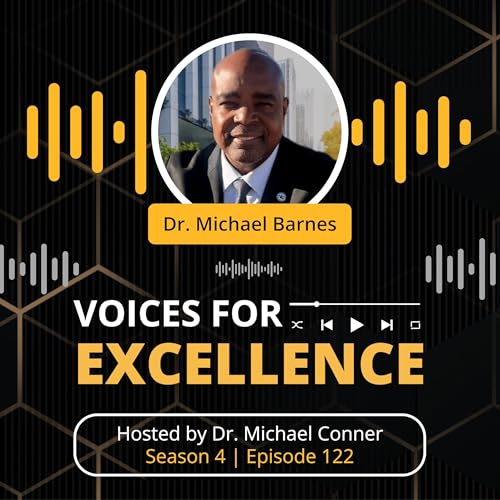
  • When the Superintendent Becomes the Chief Advocate, Everything Shifts
    Apr 20 2026

    The superintendent isn't a budget manager, they're the chief advocate for all children. Dr. Michael J. Barnes rebuilt Mayfield City Schools around this principle, and the results speak for themselves.

    The superintendent is the chief advocate for all children in their community. Nobody else can say that, not the mayor, not the school board, not the superintendent of the next district over. But somewhere along the way, superintendents drifted from the instructional chair into operations and politics. Dr. Michael J. Barnes reversed that drift entirely.

    At Mayfield City Schools (Ohio), Barnes built a four-track personalized learning model that blew up the time/learning equation. Traditional, Cross-Curricular, Self-Paced, and The Option. When students got agency over their learning design, attendance skyrocketed, not because of better discipline policies, but because students were actually designing their own learning. Time stopped being the constant. Learning became it.

    In this conversation with Dr. Conner, Barnes walks the AC-Stage reframe: what does instructional leadership look like when the industrial model is obsolete? What's the role of the superintendent in an Innovation Core? Why do design thinking, engineering, and entrepreneurship matter as much as math? How do you navigate the VUCA landscape of state politics without abandoning your moral imperative?

    What You'll Learn
    • The superintendent's real job: chief advocate for all children
    • How to flip the time/learning variable, when learning is constant, time becomes flexible
    • The four-track personalized learning model and why student agency drives attendance
    • Why instructional leadership means staying in the learning chair, not the politics chair
    • The Creative Staircase framework for systemic innovation
    • How to navigate the VUCA landscape in state politics without compromising your vision

    This conversation is essential for any superintendent or central office leader in the AC-Stage of education. Dr. Conner and Dr. Barnes dig into the frameworks that move the dial from excellence as an aspiration to excellence as a system.

    And on that note, onward and upward.

    Show More Show Less
    51 mins
  • From Creative Minds to Future Ready Centers: Rob Dickson Reimagines K-12
    Apr 6 2026

    What happens when a public school district builds a micro school inside itself, and doesn't apologize for it?

    Rob Dickson is the CIO of Wichita Public Schools (USD 259), and he's not waiting for permission to innovate. Creative Minds, a K-6 vertical classroom where kindergartners learn alongside sixth graders. Future Ready Centers that look like businesses, not classrooms, where students earn certifications in advanced manufacturing and cybersecurity. An iterative, agile approach to systems change that treats failure as feedback, not failure.

    Dickson's work bridges the operational and instructional sides of AI adoption, from changing app approval processes to training teachers on generative AI within weeks of ChatGPT's release. He argues that adaptability is the highest form of intelligence, and that schools must prepare students not for certainty, but for curiosity in the face of constant change.

    What You'll Learn:

    1. The three learning stages: K-5 learning by doing, 6-8 skill discovery, 9-12 skill development
    2. Social fitness - how Generation Alpha navigates networks of billions, not 15
    3. Why AI replaces tasks, not jobs - and what that means for curriculum design
    4. How Wichita's Future Ready Centers and Creative Minds micro school operate
    5. Arizona State's six levels of problem solving - and why academia lives in the first three
    6. Humanity, Agency, Audacity: Rob's three words for being 2035-ready

    Show More Show Less
    54 mins
  • National AI Literacy Day with Erin Mote: Why Doing Something Beats Doing Nothing
    Mar 23 2026

    What if AI isn't trying to fit into your classroom — but to rebuild it entirely?

    Erin Mote, CEO and founder of InnovateEDU, explores what it means to navigate an arrival technology, one that doesn't fit into existing systems but fundamentally reorders them. Erin leads national and international work on AI literacy, including National AI Literacy Day (March 27th), and she's not here to hype or fear-monger. She's a scout: someone managing both the promise and the peril.

    What You'll Learn:

    1. The difference between arrival technologies (AI, electricity, internet) and adoption technologies (crypto, VR)
    2. Why AI literacy is as critical in English and science as it is in computer science
    3. Real examples of AI reducing bias, optimizing bus routes, and screening for dyslexia
    4. How National AI Literacy Day (March 27) is calling in parents, students, and communities
    5. Why "do something" is the only response that matters
    6. Erin's two-word challenge: Do something
    7. Her song choice: Happy (balancing promise and peril)

    Show More Show Less
    43 mins
  • Julia Fallon on Infrastructure, Not Programs: Redesigning Around AI
    Mar 12 2026

    Can Your AI Guidance Actually Guide — Or Does It Just Add Cognitive Load?

    Thirty-five states have issued AI guidance for schools. But how many of those documents reduce workload instead of compounding it? How many build judgment muscles instead of issuing checkbox mandates? And how many actually get used in real classrooms?

    Julia Fallon, Executive Director of SETDA, has spent 25 years working with state education technology leaders to design systems that prioritize coherence over compliance. In this conversation, she reveals why effective guidance must anchor values in context, design for agency, and trust educators by default, or it will live on a shelf, ignored.

    What You'll Learn:

    1. Why AI is infrastructure, not a program, and what that means for funding and strategy
    2. The three divides from the 2024 National Ed Tech Plan: access, design, and use
    3. How No Child Left Behind's compliance trap offers lessons for AI adoption today
    4. Why reducing cognitive load is the design principle most guidance ignores
    5. What DJing on Twitch teaches about learning publicly and modeling transparency
    6. The three-word challenge: Coherence. Agency. Trust.

    Julia also shares her leadership signature song — "The Music Sounds Better with You" by Stardust — and why collective rhythm, not solo performance, defines systems-level change.

    Show More Show Less
    57 mins
  • People Before Programs: Servant Leadership, Trust, and Ethical AI with Dr. Rachel Edoho-Eket
    Feb 23 2026

    What does leadership look like when education is evolving faster than ever?

    In this powerful episode of Voices for Excellence, Dr. Michael Conner welcomes Dr. Rachel Edoho-Eket — President of the Maryland Association of Elementary School Principals, nationally recognised keynote speaker, and two-time bestselling author.

    Together, they explore:

    • Why people must come before programs

    • How relational intelligence strengthens teacher retention

    • Building trust as the foundation for school transformation

    • Ethical AI integration and protecting student privacy

    • Preparing Generation Alpha and Beta for a radically different workforce

    Dr. Edoho-Eket shares practical leadership insights grounded in service, high expectations, and culture-building. She challenges leaders to think beyond policy and focus on recommendations, adaptability, and human-centred innovation.

    The conversation closes with three anchoring principles for educational leadership today: hope, service, and love.

    If you are a principal, superintendent, educator, or system leader navigating change, this episode offers clarity and direction.

    Listen now and join the conversation.

    Show More Show Less
    46 mins
  • Authentic Leadership in Education: Dr. Paul Miller on Transforming Trauma into Triumph
    Feb 19 2026

    What if unlocking educational excellence meant embracing both our past traumas and the resilience we’ve built through them? In this compelling episode of Voices for Excellence, Dr. Michael Conner welcomes Dr. Paul Miller, an influential educator and author, as part of our Black Excellence series during Black History Month. With a visionary approach that bridges the past and future of learning, Dr. Miller's leadership and literary works challenge conventional narratives and inspire transformative change.

    Dr. Miller is currently the Chief Academic Officer at Exceptional, overseeing 27 (soon to be 29) charter schools in Rochester, New York. His dedication to educational equity, especially for Black and brown students, is reflected in his best-selling books and his mission-driven approach to school leadership. But it’s the personal stories, as much as the professional insights, that make his voice such a crucial addition to modern educational discourse.

    This episode dives into the heart of systems transformation, using Dr. Miller’s books, such as From Gutter to Greatness and The Good Me and the Hood Me, as lenses for understanding how authentic leadership and self-awareness can redefine educational outcomes. Dr. Miller unpacks the necessity of addressing personal and professional wounds to foster school environments where every student can thrive.

    What You’ll Learn:

    1. Embracing Vulnerability: Understand how acknowledging personal struggles can lead to authentic and effective leadership.
    2. Transforming Mindsets: Explore strategies for collective teacher efficacy to create meaningful change in student outcomes.
    3. Redefining Resilience: Learn how the dualities within students, such as 'the good me and the hood me,' can be strengths rather than deficiencies.
    4. Systemic Change through Storytelling: Discover how storytelling and lived experiences can inform educational practices and policies.
    5. The Power of Purpose-Driven Leadership: See how connecting personal pain to a larger purpose can drive educational excellence.

    This conversation is not just about reforming schools, it’s about reshaping the cultural narratives that drive educational systems. Dr. Miller’s insights beckon us to reimagine the future of education with a renewed commitment to authenticity, empathy, and courage.

    Subscribe and share to continue driving the future of education for all.

    Show More Show Less
    1 hr and 3 mins