Thriving Leaders Podcast cover art

Thriving Leaders Podcast

Thriving Leaders Podcast

By: Claire Gray
Listen for free

About this listen

Hosted by Claire Gray, Leadership & Team Coach and Facilitator, this podcast is here to support you as a leader, no matter what your experience level, with bite-sized leadership learnings. Packed with practical tools, tips, actions and insights, that you can immediately apply, so you can lead confidently now.Claire Gray Economics Management Management & Leadership Personal Development Personal Success
Episodes
  • Creativity is Not a Luxury, Building Creative Confidence with Paul Fairweather
    Apr 13 2026

    So many leaders are not short of ideas. What they are short of is space, confidence, and permission to bring those ideas to life. In fast-moving workplaces, creativity can feel like something we will get to later, but as Paul Fairweather reminds us in this conversation, later rarely comes.

    In this episode, I’m joined by Paul Fairweather, creative leadership speaker, workplace culture facilitator, former CEO of a 55-person architectural practice, award-winning architect, artist, and author of Bold, Brave, and A Bit Quirky. Paul helps leaders and teams reconnect with their creative confidence, not as a nice-to-have, but as a vital capability for problem-solving, connection, and innovation in a world increasingly shaped by AI.

    In our conversation, we explore what creativity really means, why so many capable people don’t see themselves as creative, and how leaders can create the conditions for more original thinking at work. We also unpack the tension between AI and human creativity, why uncertainty is part of the creative process, and what practical leaders can do to build more creative, thriving teams.

    This is such an important conversation right now, because in a world that is becoming faster, noisier, and more automated, the human skills of curiosity, creativity, courage, and connection matter more than ever.

    In this episode, we cover:

    • Why creativity is often misunderstood, and why it is about far more than art
    • How Paul defines creativity as identifying potential or opportunity, then fostering its development
    • What leaders can learn from staying longer in uncertainty, instead of rushing too quickly to clarity
    • The difference between using AI as a helpful tool, versus using it as a substitute for original thought
    • Why many adults have had their creative confidence diminished over time, and how to rebuild it
    • How simple, practical exercises can help teams think differently and unlock fresh ideas
    • What thriving teams need in order to create, connect, and contribute more meaningfully together

    I loved Paul’s reminder that creativity is not just about ideas, it is also about the courage to do something with them. Thriving teams are not built by speed alone. They are built when leaders create enough safety, space, and confidence for people to think, experiment, and contribute in more meaningful ways.

    Creativity thrives when leaders make space for uncertainty, not just answers.

    If this episode resonated, share it with a leader, teammate, or creative thinker who needs a reminder that their ideas still matter.

    Until next time, keep leading with curiosity and heart.

    Show More Show Less
    40 mins
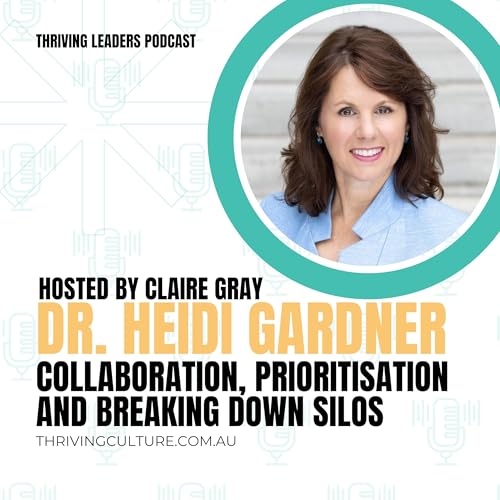
  • Collaboration, Prioritisation and Breaking Down Silos with Dr. Heidi Gardner
    Mar 30 2026

    Many leaders know collaboration matters, but far fewer have figured out how to make it work across silos, competing priorities, and complex stakeholder relationships.

    In this episode, I’m joined by Dr. Heidi Gardner, Distinguished Fellow at Harvard Law School, former Harvard Business School professor, Thinkers50 ranked thought leader, and co-author of Smart Collaboration and Smarter Collaboration. In this conversation, we explore what smarter collaboration really looks like in today’s workplace, and why working across boundaries is both more necessary and more difficult than ever. Heidi shares practical insights on trust, healthy conflict, over-collaboration, stakeholder alignment, and the leadership behaviours that create the conditions for innovation and high performance.

    In this episode, we cover:

    • Why hyper-specialisation makes collaboration harder, just as the problems leaders face become more complex and multidisciplinary
    • The importance of starting with a shared goal and being clear on each person’s role
    • How over-collaboration drains time, energy, and trust in the very idea of collaboration
    • Why conflict is not the problem, but unmanaged conflict is
    • The difference between competence trust and character trust, and why both matter
    • How leaders can create space for challenge, curiosity, and better decision-making under pressure
    • Navigating collaboration within your team and cross-functional collaboration
    • Practical ways to align with stakeholders, navigate conflicting priorities, and communicate progress toward big goals

    I loved Heidi’s reminder that collaboration is not about involving everyone in everything. It is about being intentional, drawing on the right expertise at the right moment, and creating enough trust for people to challenge each other without tipping into relationship conflict. Which is especially important in the complex environments teams are operating in.

    Smarter collaboration is not more collaboration, it’s better collaboration.

    If this episode resonated, share it with a leader or team who are navigating silos, stakeholder tension, or the complexity of cross-functional work.

    Links:

    • ⁠Smart Collaboration⁠
    • ⁠Smarter Collaboration ⁠
    • ⁠Collaborating with GenAI: Lessons from Heineken’s Use of the “PowerBot”⁠
    • ⁠Using GenAI as a Collaborative Teammate

    Show More Show Less
    51 mins
  • Your Team Is Not Disengaged. They Don’t Feel Like They Matter with Zach Mercurio
    Mar 16 2026

    Many leaders are working hard to build cultures of trust, connection, and performance, yet people still leave work feeling unseen, overlooked, or undervalued. In this conversation, I sat down with Zach Mercurio, researcher, speaker, leadership development facilitator, and author of The Power of Mattering and The Invisible Leader, to explore why the need to matter is so fundamental to how we experience work and leadership.


    What I loved about this conversation is that Zach brings together deep research with practical leadership insight. We explore why mattering is more than belonging or inclusion, how meaningful work is shaped through everyday interactions, and why psychological safety may actually be mattering in disguise. This is such an important conversation for leaders who want to build thriving teams where people feel seen, heard, valued, and needed.


    In this episode, we cover:

    (00:00) – Introduction

    (00:46) – Introduction to Zach Mercurio

    (02:20) – Why mattering is a fundamental human need

    (03:05) – The research behind meaningful work

    (35:23) – Belonging vs inclusion vs mattering

    (37:08) – Why do perks not matter

    (37:33) – Mattering and psychological safety

    (39:05) – How leaders become a secure base

    (44:47) – Recognition vs affirmation

    (45:13) – How to help people see their unique contribution

    (53:04) – The one question leaders should ask their team

    (53:52) – Final Thoughts


    This is a refreshing reminder that people do not just want to belong, they want to know they are significant. They want to feel seen, heard, valued, and needed, and when that happens, it changes how they show up, how they contribute, and how safe they feel to learn, speak up, and grow. It also made me reflect on how easy it is for leaders to focus on structure, process, and performance, while overlooking the small daily moments that communicate care and value. This conversation is a reminder that thriving teams are built in those moments.

    When people feel that they matter, they act like they matter.


    If this episode resonated with you, share it with a leader who is trying to build a more human, grounded, and psychologically safe team.

    Show More Show Less
    56 mins
No reviews yet