• Mama Trauma with Stephanie Baker
    May 21 2026

    In this episode, we're joined by Stephanie Baker, a licensed trauma counselor, Army veteran, and EMDR therapist who knows firsthand that birth doesn't always go according to plan. What started as a near-perfect pregnancy took a sharp turn, and what followed was a crash course in things nobody had prepared her for.

    Jan also pulls back the curtain on her own birth story, one she rarely shares. Let's just say it involved more than one emergency, more than one surgery, and a phone call from her mother that was... a lot.

    We laugh. We wince. We say "oh my God" a lot. Because sometimes that's the only appropriate response.

    Here's what we covered:

    • The warning signs during pregnancy that are easy to dismiss as normal
    • The grief of losing the birth experience you planned for, and why that grief is valid
    • Why guilt and shame sneak in even when none of it was your fault
    • The isolation that can come after a complicated birth, and why community matters more than most people realize
    • How to choose your birth team and actually feel safe with them
    • Doulas, breastfeeding pressure, and asking for help without feeling like a burden
    • The generational thread of moms who carried their own birth losses without ever having words for them

    Birth is wild, unpredictable, and body-hijacking, and someone really should have warned us. That's why we're here.

    About Stephanie: Stephanie Baker is a licensed trauma counselor and coach out of Mason, Ohio, who runs her own practice called Change Heals, where she helps clients untangle the kind of pain most of us were taught to just power through. She's a Licensed Professional Clinical Counselor, EMDR-trained, an Army veteran who served in Iraq, and she's a certified trainer and a member of the leadership group at the Healing Our Core Issues Institute.

    If you've read Gifts from a Challenging Childhood, you've actually already met a piece of her work — one of her original techniques is in there, in the 2025 edition. So she's not just teaching the model. She's helping shape it.

    Stephanie is the therapist a lot of us wish we'd had earlier. She's deeply relational — human first, clinician second — and she shows up in the room as a real person, not a role. What she does so beautifully is help clients understand themselves in ways they were never given permission to before. The patterns, the protective parts, the why underneath the behavior — she helps her clients see all of it with curiosity instead of shame. She works with people healing developmental trauma — the stuff our mothers definitely forgot to mention- and she does it with humor, heart, and zero pretense.

    Stephanie’s Links:
    Stephanie’s Website
    Intensive Workshops
    Stephanie’s Instagram

    Find resources mentioned in this episode here.

    Learn more about this podcast here.

    Submit your 90-second lesson/experience here.

    Apply to be a guest here.

    Stay updated on new episodes here.

    *Information shared on this podcast is not medical advice. If you have a concern about your physical or mental health, please seek support from a proessional.

    Show More Show Less
    56 mins
  • Open Wide: Horror Stories From the Chair
    May 7 2026

    Teeth. The thing nobody warns you about until you're crying in the dental chair with half your face numb and a stranger drilling into your mouth for the third time that visit.

    This episode is Jan and Patti getting brutally honest about their dental horror stories—the bad dentists, the botched procedures, the money spent, and the hard-won lessons that came out the other side. Spoiler: we both came out stronger (and way more committed to flossing).

    What we get into this episode:

    • Jan's childhood dentist, who did fillings with zero Novocaine (yes, really)
    • Why the dentist's chair can trigger real anxiety and panic, especially if feeling trapped is your thing
    • Patti's multi-year nightmare with a dentist who was charming, attractive, and genuinely bad at his job
    • The very expensive lesson in people-pleasing and not trusting your gut
    • When to see a specialist vs. letting your general dentist handle it
    • Teeth grinding, Invisalign, and Jan's $12,000 smile glow-up
    • Medications, dry mouth, and tooth loss — something no one talks about enough
    • The real reason so many of us go years without seeing a dentist

    Bottom line? Trust your gut, get referrals from someone who's had real work done, and for the love of everything — brush and floss twice a day. Your future self will thank you.

    Find resources mentioned in this episode here.

    Learn more about this podcast here.

    Submit your 90-second lesson/experience here.

    Apply to be a guest here.

    Stay updated on new episodes here.

    *Information shared on this podcast is not medical advice. If you have a concern about your physical or mental health, please seek support from a proessional.

    Show More Show Less
    35 mins
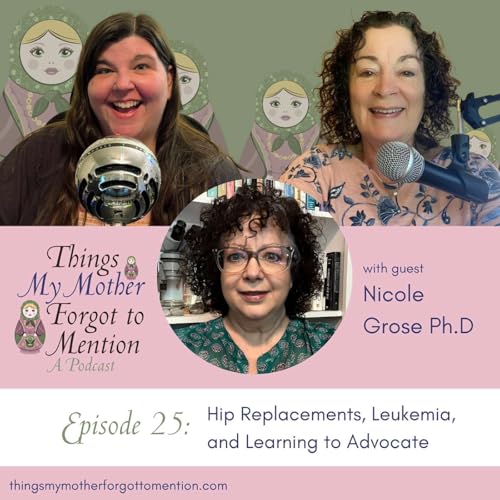
  • Hip Replacements, Leukemia, and Learning to Advocate with Nicole Grose Ph.D
    Apr 16 2026

    Nobody sat us down and said, "Hey, one day your hips might just stop working." And yet here we are.

    In this episode, Jan and Patti are joined by the brilliant Nicole Grose, a retired professor, Gen X middle child, leukemia survivor, and now the proud owner of two brand-new hips. Nicole brings her background in anatomy and physiology (and a whole lot of hard-won personal experience) to a conversation that is equal parts eye-opening and deeply real.

    We talk about what it actually looks like to navigate joint replacement surgery, from the frustrating search for the right surgeon, to recovering mid-COVID, to the very specific math of being told your new hip will last 40 years when you have leukemia.

    This one's for every woman who's ever been waved off by a medical professional, told to push through the pain, or simply never given the full picture of what her body might need someday.

    About Nicole Grose Ph.D:

    Nicole obtained a Ph.D. in Quantitative Biology, studying the relationship between the nervous and immune systems. She is a recently retired professor who spent nearly 2 decades teaching college-level anatomy, physiology and animal physiology from 2003 to 2021.Her academic expertise and personal experience brings a unique perspective to conversations regarding joint replacement and long-term health. Living with chronic leukemia, Nicole understands firsthand the challenges and realities of navigating complex medical decisions, procedures and subsequent recovery. A GenX middle child of five and longtime educator at heart, Nicole now enjoys splitting her time between Dallas and Michigan's Upper Peninsula.

    Nicole is developing an academic success/tutoring business with the goal of assisting STEAM students in developing the skillset to succeed academically as well as in the workplace.

    Find resources mentioned in this episode here.

    Learn more about this podcast here.

    Submit your 90-second lesson/experience here.

    Apply to be a guest here.

    Stay updated on new episodes here.

    *Information shared on this podcast is not medical advice. If you have a concern about your physical or mental health, please seek support from a proessional.

    Show More Show Less
    43 mins
  • The Joint Adventure: Hips, Knees, and Everything Nobody Told You
    Apr 2 2026

    So Jan's basically building a new body one joint at a time, and we figured it was time to talk about it.

    As of recording, Jan is eight weeks out from her fourth joint replacement, a knee this time, and we got into all of it. The parts they don't put in the brochure. The stuff your surgeon forgets to mention. The real experience of living in a body that needs a little extra hardware to keep going.

    If you have a joint replacement in your future, or your mom does, or you're just trying to figure out how to stay mobile as you age, this one is genuinely useful. We promise.

    Here's what we covered:

    • How to know when it's actually time for a joint replacement and what the road there typically looks like
    • Why the surgeon you choose matters more than you think, and what Jan learned the hard way from her first hip
    • How robotic surgery has changed everything, making procedures more precise and often fully outpatient
    • Scar tissue, fascia, and why rehab is non-negotiable for some bodies more than others
    • Why strength training before surgery is one of the best things you can do for your recovery
    • What those first days home actually look like and why having someone there is not optional
    • How to protect the joints you've already had replaced so they actually last

    If you've been through a joint replacement yourself, or you're heading into one, you already know this conversation was a long time coming. And if you haven't, consider this your heads up that your future self will thank you for listening now.

    Find resources mentioned in this episode here.

    Learn more about this podcast here.

    Submit your 90-second lesson/experience here.

    Apply to be a guest here.

    Stay updated on new episodes here.

    *Information shared on this podcast is not medical advice. If you have a concern about your physical or mental health, please seek support from a proessional.

    Show More Show Less
    36 mins
  • Obesity, Eating Disorders & the Shame No One Names with Melinda J Watman
    Mar 19 2026

    This week, Jan connected us with Melinda Watman, a woman who has lived inside the obesity and eating disorder world since she was two and a half years old, and who somehow turned that into a career that's literally changing how pharmaceutical companies and clinical trials treat patients. We had a feeling this conversation was going to be good. We had no idea.

    Melinda is a patient advocacy consultant, a former CEO, a French restaurant owner (yes, really), and a person who has had bariatric surgery, survived three concurrent eating disorders, and came thisclose to not being here. She's also as honest as we love our guests to be!

    We talked about:

    • Why obesity is a disease, not a character flaw.
    • The food noise.
    • Bariatric surgery and what nobody prepares you for.
    • How Melinda ended up with three eating disorders at once.
    • The moment something shifted.
    • GLP-1 medications, the real talk.
    • Weight bias in healthcare.
    • Her "village" approach to recovery.
    • Why childhood obesity and eating disorders are rising together, and why the cruelest bullying still goes unchecked.

    The line that stayed with us: "I thought my goal was to be the skinniest girl in the room. It took me a long time to realize I was actually the sickest girl in the room."

    If you've ever felt shame around your body, your eating, or your weight, or if you love someone who has, this episode is for you. You are not weak. You are not broken. And you are not alone.

    About Melinda:

    Ms. Watman is the founder of Weighty Decision, a patient advocacy consultancy partnering with pharmaceutical companies in the anti-obesity medication space. She provides both internal and external stakeholders patient-centered frameworks that improve engagement and outcomes. Drawing on 15 years of clinical experience and an MBA-driven entrepreneurial career, she bridges healthcare delivery, policy, and innovation. Ms. Watman is a compelling and trusted voice on the lived experience of obesity, healthcare bias, eating disorders, and patient-centered innovation.

    In addition to her clinical practice, her background includes founding two successful consulting firms, serving as CEO and co-founder of a medical device company, working with both startups and established organizations to bring novel healthcare technologies to market, and owning a French restaurant.

    She is a strong believer in giving back and is a mentor with the MIT Venture Mentoring Service and Innovate@BU. She also is an Emeritus board member of the Obesity Action Coalition.

    Melinda will be speaking this year on eating disorders with obesity at two upcoming professional conferences: the American Society for Metabolic and Bariatric Surgery and the World Obesity and Weight Management Congress. She is also involved with an advocacy effort to maintain coverage for anti-obesity medications for MassHealth/Medicaid patients in Massachusetts.

    Connect with Melinda on LinkedIn.

    Find resources mentioned in this episode here.

    Learn more about this podcast here.

    Submit your 90-second lesson/experience here.

    Apply to be a guest here.

    Stay updated on new episodes here.

    *Information shared on this podcast is not medical advice. If you have a concern about your physical or mental health, please seek support from a proessional.

    Show More Show Less
    56 mins
  • Permission to Eat: Healing Disordered Eating
    Mar 5 2026

    Today we’re talking about something so many women carry quietly: disordered eating and body image stuff. We get honest about our own histories (yep, both ends of the spectrum) and what actually helped us move toward peace—without shame, perfection, or “just try harder” nonsense.

    In this episode, we talk about:

    • How eating disorders aren’t just anorexia and bulimia—there’s a whole range of disordered eating behaviors
    • Patti’s experience with control, trauma, food hiding, bingeing, and the shame spiral
    • Jan’s experience with thinness pressure, dance culture, and bingeing/purging without even knowing what it was called
    • Why food often becomes a coping tool (just like alcohol, drugs, work, shopping… you get it)
    • How body dysmorphia messes with what we think we see in the mirror
    • The sneaky messages we absorb from family, culture, and “well-meaning” comments
    • Why therapy matters (because food is rarely the real issue)
    • The power of permission: eating carbs, adding snacks, and even having dessert on purpose

    If you’re struggling, here’s what we encourage:

    • Consider therapy with someone who understands trauma + body image
    • Work with a registered dietitian/nutritionist who doesn’t shame bodies (HAES-aligned can be a great fit)
    • Start small with body neutrality: “I’m not broken” is a powerful first step

    Find resources mentioned in this episode here.

    Learn more about this podcast here.

    Submit your 90-second lesson/experience here.

    Apply to be a guest here.

    Stay updated on new episodes here.

    *Information shared on this podcast is not medical advice. If you have a concern about your physical or mental health, please seek support from a proessional.

    Show More Show Less
    42 mins
  • The Grief Timeline: How Loss Shapes Us with Dr. Rick Butts
    Feb 19 2026

    The conversation this week with our colleague and friend, Dr. Rick Butts, stopped us in our tracks—in the best way.

    Rick walked us through his grief timeline, beginning with losing his grandmother at 7, his father at 10, and later his mother at 35. What unfolded was something we hadn’t quite thought about before: grief isn’t just an event… it’s a thread that runs through your entire life.

    In this episode, we talk about:

    • Why many of us get “stuck” in one stage of grief (hello, denial)
    • How childhood loss quietly shapes adult coping patterns
    • Why unprocessed grief lives in the body
    • The idea that all counseling is grief work
    • What it means to complete a “threat response”
    • How to create your own grief timeline
    • Why retirement, divorce, moving, and unmet expectations are real losses
    • How mindfulness helps us embody grief instead of outrun it
    • The power of meaning-making in healing

    Rick vulnerably shares his own journey—from shutting down as a 10-year-old boy to fully grieving decades later through experiential therapy.

    And we ask the big question:

    Where are you in your grief timeline?

    If this episode stirred something in you, you’re not alone. Grief is not weakness. It’s human. And you don’t have to move through it by yourself.

    About Dr. Rick Butts:

    Rick has been a therapist for the past 37 years. During this time, he has been a professor at two different Universities. At the University of Cincinnati, he taught in the Human Social Services department. And at the Cincinnati Christian University, he taught in their Master of Arts in counseling program. Throughout these 37 years, he has maintained a private practice focused for several years on children, adolescents, and families. Then he transitioned to adults with an interest in developmental and relational trauma and couples counseling. In 2013, he co-founded the Healing Our Core Issues Institute with Jan Bergstrom, which is a training program for therapists, social workers, marriage and family therapists, psychologists, and coaches.

    Website: https://www.drrickbutts.com

    Find resources mentioned in this episode here.

    Learn more about this podcast here.

    Submit your 90-second lesson/experience here.

    Apply to be a guest here.

    Stay updated on new episodes here.

    *Information shared on this podcast is not medical advice. If you have a concern about your physical or mental health, please seek support from a proessional.

    Show More Show Less
    44 mins
  • The Grief of Everything
    Feb 5 2026

    In this episode, we talk about the many faces of grief—and how it's not just about death. From heartbreak and dementia to aging bodies and old friendships, this one’s for anyone who’s had to say goodbye to something (or someone) they loved.

    We get into:

    • The sneaky, shapeshifting nature of grief
    • What “ambiguous grief” actually means
    • How grief is deeply connected to attachment
    • Why we need rituals—and how they help us move through pain
    • Grief triggers and how to cope
    • Creating meaning from loss (even when it feels impossible)

    Whether you’re in it, past it, or dreading it—this conversation will meet you where you are.

    Find resources mentioned in this episode here.

    Learn more about this podcast here.

    Submit your 90-second lesson/experience here.

    Apply to be a guest here.

    Stay updated on new episodes here.

    *Information shared on this podcast is not medical advice. If you have a concern about your physical or mental health, please seek support from a proessional.

    Show More Show Less
    41 mins