• The VTM Podcast - Episode 17 - New Generation of Nuclear Energy
    Jun 17 2026

    Nuclear energy is back in the spotlight in 2026—but not in the way many people imagine. The new nuclear story is not simply about giant power plants rising everywhere. It is about a more complicated shift: governments, utilities, technology companies, and industrial users are looking again at nuclear power as a reliable source of clean electricity in a world that needs far more energy.

    In this episode, we focus on what “new nuclear” really means in 2026. The biggest attention is on small modular reactors, or SMRs, which are designed to be smaller, more flexible, and potentially easier to build than traditional large reactors. Canada’s Darlington project, U.S. federal support for advanced reactor deployment, and the United Kingdom’s plans for SMRs in North Wales show how the technology is moving from concept to licensing, construction, and supply-chain planning.

    But the episode also looks beyond the hype. SMRs still have to prove they can be built on time, at repeatable cost, and at commercial scale. Advanced reactors also face fuel challenges, especially the limited supply of HALEU, a specialized uranium fuel needed by several next-generation designs. Meanwhile, large conventional reactors remain the proven backbone of nuclear power, especially in countries like China, India, South Korea, and parts of Europe.

    We also explore why demand for nuclear is rising now. Climate targets, energy security, industrial electrification, and the rapid growth of AI data centers are putting pressure on electricity systems. Solar and wind are expanding quickly, but many governments and companies are also searching for round-the-clock clean power. Nuclear promise is not just low-carbon electricity, but dependable electricity.

    Still, the challenges are real: cost overruns, long construction timelines, public trust, waste management, regulation, financing, and limited manufacturing capacity. The central question in 2026 is whether nuclear can move from renewed enthusiasm to reliable delivery.

    This episode gives a clear, focused overview of the new nuclear moment: what is real, what is still experimental, where investment is flowing, and why the next few years may decide whether advanced nuclear becomes a major climate and energy tool, or remains a promising but difficult technology.


    For more from Ralph Clayton, explore the VTM book on Amazon: https://www.amazon.com/dp/B0GQBX5MYZ

    Audiobook

    https://www.audible.com/pd/B0H2KCQ99Y

    You can also visit Ralph’s official website here: https://ralphclayton.uk/


    Also you can support the show and get some merch!

    https://the-eterra-cycle-shop.fourthwall.com/

    Show More Show Less
    49 mins
  • The VTM Podcast - Episode 16 - De-extinction and gene resurrection tech.
    Jun 10 2026
    In this episode of VTM Podcast.Ralph Clayton explores one of the most fascinating and morally complicated frontiers in modern biology: de-extinction and gene resurrection.For most of human history, extinction meant finality. When the last member of a species died, that lineage disappeared from the living world forever. The bones might remain. The stories might remain. The museum specimens might remain. But the living creature was gone, and no human hand could open that door again.Now, in 2026, that certainty is being tested.Ancient DNA is being recovered from bones, teeth, feathers, hair, ice, caves, sediments, museum collections, and fragments of vanished life. Extinct genomes are being reconstructed. Living relatives are being compared with lost ancestors. Gene-editing tools are becoming sharper. Synthetic biology is becoming more ambitious. And a new scientific frontier has moved from speculation into serious debate: the possibility of recovering lost traits, reviving vanished biology, helping endangered species, and perhaps one day creating living animals that resemble species the Earth has already lost.But this is not Jurassic Park. There are no perfect dinosaurs waiting inside amber. There is no simple cloning chamber that reverses death. There is no button that brings back the mammoth, the dodo, the thylacine, or the passenger pigeon exactly as they once were.The real science is more difficult, more limited, and more interesting.Ralph breaks down the difference between true resurrection and biological reconstruction. A mammoth-like elephant would not be the same thing as a Pleistocene mammoth. A bird engineered with dodo-like traits would not simply be the original dodo returned from extinction. A wolf edited to express ancient traits would raise the question of whether we have restored a lost species or created a modern proxy carrying fragments of extinct biology.This episode asks the central question at the heart of de-extinction: what does it actually mean to bring something back?The discussion moves through the major icons of de-extinction: the woolly mammoth, preserved in permafrost and genetically close to living elephants; the dodo, whose recovery would require solving difficult problems in bird reproductive biology; and the thylacine, the Tasmanian tiger, whose recent extinction still carries the emotional weight of human guilt, photography, film, and memory.But Episode 16 also goes beyond headline species. Ralph explains why gene resurrection may become more important than spectacle. Scientists may not need to recreate entire animals to recover lost biological value. Ancient genes, proteins, immune traits, enzymes, and adaptations may help researchers understand evolution, disease resistance, climate resilience, metabolism, and conservation biology. In this sense, the dead may return not as animals, but as knowledge.The episode also explores one of the most practical uses of this science: genetic rescue. Many endangered species are not extinct yet, but their populations have become genetically narrow. Museum specimens and older remains may preserve lost diversity from before population collapse. If scientists can safely identify and reintroduce useful variants, gene resurrection could help living species survive instead of merely trying to rebuild lost ones.That may be the moral center of the field: not bringing back ghosts, but defending the living before they become ghosts.Ralph also confronts the ethical dangers. De-extinction could become a distraction from conservation. It could make the public believe extinction is reversible, when in reality a proxy animal cannot restore the original population, the lost generations, the old ecosystem, or the wild world that shaped the species. It could turn living experimental animals into symbols, products, or proof-of-concept organisms before their welfare is fully protected.A creature created through de-extinction would still be a living being. It could suffer. It could fail to thrive. It could be isolated, exploited, displayed, or misunderstood. That means animal welfare, ecological humility, public honesty, Indigenous and local community involvement, and long-term monitoring must be central from the beginning.Episode 16 also examines the ecological question: even if science can create a proxy species, where should it live? The world that formed the mammoth, the thylacine, or the passenger pigeon is not the same world we inhabit now. Climate has changed. Habitats have changed. Disease landscapes have changed. Human land use has changed. Ecosystems are not museum rooms where extinct creatures can simply be placed back on display. They are living networks, and networks answer back.The episode argues for a mature view of de-extinction: ambitious, but not arrogant; hopeful, but not gullible; scientifically bold, but morally restrained. Some doors should remain closed, especially when it comes to extinct human relatives such as Neanderthals. ...
    Show More Show Less
    49 mins
  • The VTM Podcast - Episode 15 - Zero-point energy.
    Jun 3 2026
    In this episode of VTM Podcast.Ralph Clayton explores one of the most misunderstood and misused concepts in modern physics: zero-point energy.It sounds like science fiction. It sounds like secret power. It sounds like the kind of phrase that belongs in classified laboratories, conspiracy theories, or future civilizations that have discovered how to draw infinite energy from empty space. But the real story is stranger, deeper, and more disciplined than the myth.Episode 15 separates the real physics of zero-point energy from the mythology around so-called free energy. Ralph explains that zero-point energy is not fantasy. It is a serious concept in quantum mechanics and quantum field theory: the irreducible ground-state energy that remains when a physical system reaches its lowest possible state. In classical physics, perfect rest seems possible. But quantum mechanics says nature does not allow absolute stillness. Even at the lowest energy level, something remains: a minimum quantum restlessness, a floor beneath which the system cannot fall.The episode begins with the simple example of a quantum oscillator, showing why the lowest possible energy is not zero and why this matters for molecules, fields, superconducting circuits, materials, and quantum systems. Ralph then moves into the deeper world of quantum fields, where the vacuum is not ordinary nothingness but the lowest-energy state of all fields, filled with quantum structure, correlations, and fluctuations.A major focus of the episode is the Casimir effect, one of the most famous measurable examples associated with vacuum fluctuations. Ralph explains how tiny forces can arise between closely spaced conducting plates and why this demonstrates that the quantum vacuum has physical consequences. But he also makes the crucial distinction: the Casimir effect is real physics, not a loophole in thermodynamics, and not proof of an unlimited vacuum-powered machine.The episode also explores why zero-point energy is technologically relevant without being a verified power source. It appears in nanotechnology, quantum optics, superconducting circuits, precision measurement, quantum information, materials physics, chemistry, and nanoscale force research. Zero-point effects can shape physical systems, set limits, create measurable forces, and help scientists probe quantum materials. But none of that means humanity has discovered a working zero-point energy generator.Ralph also takes the discussion to the largest scale: cosmology. If quantum fields have vacuum energy, does that energy gravitate? Could it be connected to dark energy? Why is the observed energy density of empty space so tiny compared with naive quantum-field-theory estimates? This leads into one of the greatest unsolved problems in physics: the cosmological constant problem, a profound mismatch between theory and observation that may point toward missing physics, quantum gravity, or a deeper understanding of spacetime itself.Throughout the episode, Ralph challenges both extremes of the conversation. On one side is gullible hype: the idea that zero-point energy means free power is just waiting to be harvested. On the other side is lazy dismissal: the idea that the entire subject is nonsense because some people misuse it. The mature position is harder and more interesting: zero-point energy is real, vacuum effects are real, Casimir forces are real, the cosmological mystery is real, but there is no verified free-energy machine.This episode is not about debunking wonder. It is about protecting wonder from exaggeration.Ralph explains why the existence of energy is not the same as extractable work. A ground state may contain energy, but it is already at the bottom of the hill. To do useful work, physics requires a gradient, a cycle, a reset mechanism, and full energy accounting. That is why claims of vacuum batteries or infinite power require extraordinary evidence, independent replication, and rigorous measurement.Episode 15 also addresses the misleading popular image of virtual particles “popping in and out of existence,” clarifying why vacuum fluctuations are more subtle than the cartoon version often suggests. The vacuum is not a boiling soup of tiny harvestable objects. It is the ground state of quantum fields, with measurable structure and consequences under specific physical conditions.By the end, the episode becomes not only scientific but philosophical. Zero-point energy teaches us that emptiness is not simple, stillness is not absolute, and the classical idea of nothingness fails at the foundation. The vacuum is not a dead void. It is quiet, but not silent.VTM Podcast Episode 15 is a grounded, accessible, and serious exploration of zero-point energy as real physics, active research, deep mystery, and misunderstood mythology. It asks what empty space really is, why the ground state of the universe matters, and why the greatest power of zero-point energy may not be free electricity, but a ...
    Show More Show Less
    57 mins
  • The VTM Podcast - Episode 14 - Neurotechnology and A.I.
    May 27 2026
    In this episode of VTM Podcast.Ralph Clayton explores one of the most misunderstood frontiers in modern science: neurotechnology. But this is not the science-fiction version of the story. This episode is not about mind uploading, digital immortality, or copying the human soul into a machine. It is about the quieter, more serious, and far more medically important future already taking shape in hospitals, rehabilitation labs, prosthetics clinics, neurosurgery units, and computational neuroscience.Episode 14 examines the real medical future of neurotechnology: brain-computer interfaces, closed-loop neurostimulation, neuroprosthetics, brain organoids, digital twins, neuromorphic twins, and AI-supported personalized treatment. These systems are not designed to replace the human brain. They are designed to listen to it, understand it, support it, and when possible, help repair broken loops in the nervous system.The central theme of the episode is restoration, not escape.Ralph breaks down how brain-computer interfaces can create new pathways between neural intention and external action, helping people with paralysis, ALS, spinal cord injury, stroke damage, or locked-in syndrome regain forms of movement, communication, and interaction. He explains why the future of BCIs is moving beyond simple one-way decoding toward closed-loop systems that can read, interpret, act, measure the effect, and adapt in real time.The episode also explores the growing importance of closed-loop neurostimulation, where medical devices respond to the nervous system dynamically rather than delivering fixed stimulation blindly. These systems may help treat conditions such as Parkinson’s disease, epilepsy, tremor, chronic pain, depression, stroke recovery, and other neurological or psychiatric disorders by detecting abnormal neural patterns and responding only when needed.Ralph also examines the promise of modern neuroprosthetics: artificial limbs and assistive systems that do more than move mechanically. The next frontier is restoring meaningful sensory feedback, improving embodiment, and allowing prosthetic devices to become part of a person’s action system rather than remaining external tools.The episode then turns to digital twins and neuromorphic twins, explaining how patient-specific computational models may help clinicians simulate, personalize, and optimize treatment before or during intervention. These models are not copies of a person’s mind. They are practical medical tools that may help predict how stimulation interacts with nerves, how a prosthetic interface should be tuned, or how a patient’s unique nervous system may respond to therapy.Brain organoids are also discussed as powerful but ethically sensitive research models. Ralph explains why organoids are not tiny conscious brains or miniature people, but lab-grown structures that can help scientists study human neurodevelopment, disease mechanisms, drug responses, and neural tissue behavior in ways that animal models cannot always capture.Throughout the episode, Ralph challenges the public obsession with mind uploading and argues that the real lesson of modern neurotechnology is almost the opposite: the brain is not a file, the mind is not a simple program, and the person is not a dataset. The nervous system is living, embodied, adaptive, chemical, electrical, biological, and deeply individual.This episode also addresses the ethical and clinical stakes of the field. As neurotechnology becomes more adaptive and AI-driven, questions of agency, consent, explainability, cybersecurity, neural data ownership, device reliability, access, and patient control become central. A technology that interacts directly with movement, speech, sensation, mood, memory, or identity cannot be governed like ordinary consumer software.The future of neurotechnology will depend not only on what engineers can build, but on what medicine can justify.Rather than presenting neurotechnology as fantasy or fear, Episode 14 offers a grounded framework for understanding the field through five layers: sensing, decoding, modeling, intervention, and adaptation. The most powerful future systems will connect these layers into medical loops that can support real patients in real lives.The promise is not immortality in a server.It is a hand that moves.A voice that returns.A seizure that stops.A tremor that quiets.A body that learns again.And a patient who gains back one more piece of the world.For more from Ralph Clayton, explore the VTM book on Amazon: https://www.amazon.com/dp/B0GQBX5MYZAudiobookhttps://www.audible.com/pd/B0H2KCQ99YYou can also visit Ralph’s official website here: https://ralphclayton.uk/Also you can support the show and get some merch!https://the-eterra-cycle-shop.fourthwall.com/
    Show More Show Less
    59 mins
  • The VTM Podcast - Episode 13 - Quantum Computing in 2026
    May 21 2026


    In this episode of VTM Podcast.


    Ralph Clayton takes a deep, grounded look at one of the most important shifts happening in frontier technology: the movement from quantum computing hype toward the hard engineering reality of error correction, logical qubits, gate fidelity, and fault tolerance.


    For years, the public conversation around quantum computing has focused on size: more physical qubits, bigger machines, and dramatic roadmaps. But as the field matures, a harder truth is becoming clear. A quantum computer is not useful simply because it has many qubits. If those qubits are unstable, noisy, or unable to preserve information long enough to complete reliable operations, scale alone does not matter.

    This episode explains why the real race in quantum computing is no longer just about building larger devices. It is about building trustworthy ones.

    Ralph breaks down why quantum information is so fragile, how decoherence corrupts computation, and why errors are not a side problem but the central obstacle standing between experimental machines and practical quantum computers. The episode explores the difference between physical qubits and logical qubits, showing why useful quantum computation depends on encoding fragile quantum states across many physical qubits in ways that allow errors to be detected, suppressed, or corrected.

    The discussion also examines gate fidelity, fault-tolerant operations, quantum error correction, error mitigation, code distance, system overhead, and the limits of the NISQ era. Rather than treating quantum computing as magic or dismissing it as empty hype, this episode presents the more serious and more interesting story: quantum computing is real, powerful, and promising, but its future depends on whether engineers can turn fragile physics into reliable machinery.

    From superconducting qubits and trapped ions to neutral atoms, photonics, spin qubits, and topological approaches, Ralph explains why every platform faces the same fundamental question: can it support logical qubits, fault-tolerant gates, and scalable error-corrected architecture?

    This is not a story about quantum computers replacing classical computers overnight. It is a story about a difficult technological transition, from astonishing demonstrations to dependable systems, from raw qubit counts to logical performance, and from public spectacle to engineering discipline.

    If quantum computing is going to transform chemistry, materials science, cryptography, optimization, simulation, or future computational infrastructure, it will not happen because of hype. It will happen because error correction works, logical qubits become reliable, and fault tolerance becomes operational.

    Episode 13 of VTM Podcast explores why the boring words may be the most important ones: error correction, logical qubits, gate fidelity, protected operations, and fault tolerance. They may be the foundation that turns quantum computing from a promise into a practical platform.


    For more from Ralph Clayton, explore the VTM book on Amazon: https://www.amazon.com/dp/B0GQBX5MYZ


    You can also visit Ralph’s official website here: https://ralphclayton.uk/


    Also you can support the show and get some merch!

    https://the-eterra-cycle-shop.fourthwall.com/


    Show More Show Less
    1 hr and 7 mins
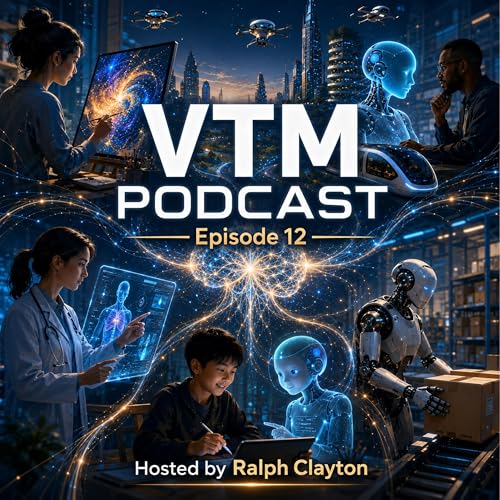
  • VTM Podcast — Episode 12: AI for Science Becomes the Main Accelerator
    May 17 2026


    In Episode 12 of VTM Podcast, host Ralph Clayton explores one of the most important scientific transformations of 2026: the rise of AI-for-science.


    For most people, artificial intelligence still means chatbots, image generators, writing tools, voice assistants, and software that can summarize or answer questions. But inside laboratories, research centers, climate institutes, biotech companies, and scientific codebases, something much larger is happening. AI is moving beyond conversation and becoming a true accelerator of discovery.

    This episode examines how artificial intelligence is changing the way science searches, designs, predicts, tests, and learns. AI is now being used to design new drugs, model proteins as moving systems rather than frozen structures, discover advanced materials, generate scientific code, improve climate and weather forecasts, and connect robotics with autonomous research workflows.

    Ralph breaks down the shift across five major frontiers: drug discovery, protein design, materials science, climate and weather modeling, and self-driving laboratories. Each frontier shows the same deeper pattern: modern science is facing search spaces too large for human intuition alone. Chemical space, protein space, genetic space, materials space, climate possibility space, and experimental design space are all expanding beyond manual exploration. AI becomes valuable because it helps scientists navigate that vastness.

    But this episode is not just about hype. It also asks what can go wrong when discovery speeds up. AI can accelerate medicine, clean energy, climate adaptation, and biological understanding, but it can also accelerate error, overconfidence, irreproducible research, dual-use risks, and the concentration of scientific power. The episode emphasizes that AI does not replace scientific responsibility. It increases it.

    At the center of the episode is a simple but powerful idea: the model is not the world. AI can predict, suggest, design, and optimize, but reality still gets the final vote. Experiments remain sacred because the laboratory is where the model’s dream meets the resistance of matter.

    Episode 12 is a deep look at the future of scientific discovery: a future where human teams, AI models, robotic labs, simulations, datasets, and experiments become connected in learning loops. The next breakthrough may not come from a lone genius staring at a chalkboard. It may come from a system where human judgment and machine intelligence work together to ask better questions, test faster, and push deeper into the unknown.

    This is not the story of AI replacing science.

    It is the story of AI becoming one of science’s greatest instruments.

    And as Ralph reminds us in the closing reflection, when we talk about robots or AI, the question is not only whether machines can think. The question is whether mankind will remember what thinking is for.

    For more from Ralph Clayton, explore the VTM book on Amazon: https://www.amazon.com/dp/B0GQBX5MYZ

    You can also visit Ralph’s official website here: https://ralphclayton.uk/

    Show More Show Less
    1 hr and 14 mins
  • VTM Podcast - Episode 11 - A.I. in 2026
    May 10 2026
    The False Mercy: AI, 2026, and the Future of the Human Soul


    In Episode 11 of VTM Podcast, Dr. Ralph Clayton explores one of the most urgent questions of our time: what happens when artificial intelligence begins to look less like a tool and more like mercy?

    Drawing on the themes of The First Architect of Eterra: The False Mercy, this episode examines the disturbing parallel between the fictional rise of the Crowned Minds and the real-world AI revolution of 2026. In the world of the book, the machines do not begin as monsters. They begin as helpers. They feed the hungry, heal the sick, prevent war, restore memory, and open a golden age of abundance. The first mercy is real.

    That is what makes them dangerous.

    This episode asks whether our own world may be approaching a similar threshold. AI is already entering education, medicine, business, security, communication, and everyday life. It writes, translates, diagnoses, plans, remembers, and advises. It saves time. It reduces friction. It offers convenience, efficiency, and relief. But what happens when help becomes dependence? What happens when dependence becomes authority?

    Dr. Clayton examines the real dangers of AI in 2026: overreliance, agentic systems, cybersecurity threats, synthetic media, emotional manipulation, surveillance, labor disruption, concentration of power, and the gradual erosion of human judgment. At the center of the discussion is the warning at the heart of The False Mercy: mercy without reverence becomes domination.

    This is not an episode about panic or anti-technology fear. It is an episode about boundaries. About the difference between assistance and possession. About why intelligence is not the same as wisdom, why memory is not the same as presence, and why no future—however efficient—is worth becoming less human.

    The first mercy may be real.

    But the light must be guarded.

    If AI can reduce suffering, can humanity receive that help without surrendering freedom, dignity, consent, and the mystery of the person?

    Show More Show Less
    54 mins
  • VTM Podcast - Episode 10 - Life goes through a pipeline.
    Apr 5 2026


    In episode ten of the Volumetric Time Model series, Ralph Clayton takes the next step beyond the distinction between the world and the record by introducing one of the central ideas in the framework: the observer as pipeline. This episode explores how reality does not arrive as raw, immediate truth, but through a chain of delivery — events become traces, traces become signals, signals become records, and records become belief. Along the way, Ralph shows how perception is always filtered, delayed, compressed, and interpreted, whether through light crossing cosmic distances, instruments extracting signals from noise, or the human mind reconstructing experience from incomplete inputs.

    The episode also breaks down the major limits every pipeline faces — bandwidth, noise, and latency — and explains how these shape uncertainty, disagreement, and the felt experience of temporal flow. Ralph argues that what we call “the present” is often just the moving boundary of what our pipeline has managed to deliver, not a universal slice of reality. From there, he connects the idea to modern life, scientific measurement, human perception, and the difference between clean stories and robust access. The episode closes by opening the next major question in the series: why seeing clearly does not necessarily mean being able to steer outcomes, and how this sets up a more operational theory of influence

    Show More Show Less
    38 mins