Episodes

  • Ahasuerus_Butaddeus_Cartaphilus: The Story of the Wandering Jew
    May 21 2026

    The legend of the immortal wanderer condemned to roam the Earth until the Second Coming of Christ represents one of the most complex apocryphal syntheses in Western cultural history. Although the figure has no explicit, direct basis in the canonical New Testament, its theological foundations were retroactively constructed from a constellation of biblical passages and typological motifs. The primary textual catalyst is found in the Gospel of John, which records an officer of the high priest striking Jesus during his arraignment before Annas (John 18:20–22). This act of physical transgression was subsequently conflated with Christ's eschatological pronouncement in Matthew 16:28, wherein he declares that some standing there "shall not taste of death, till they see the Son of man coming in his kingdom".

    Show More Show Less
    20 mins
  • Faustian Bargains_ Paganini, Wilde, Johnson.
    May 21 2026

    The archetype of the Faustian bargain—the forfeit of the immortal soul in exchange for transcendent worldly power, beauty, or genius—serves as one of the most enduring narrative frameworks in Western culture. This structural paradigm undergoes a profound evolution when tracked across different mediums, centuries, and cultural landscapes. By analyzing the historical biography of Italian violinist Niccolò Paganini, the literary architecture of Oscar Wilde’s The Picture of Dorian Gray, and the syncretic folklore surrounding Delta blues pioneer Robert Johnson, a compelling transition emerges. Historically, this trajectory moves from the physicalized, superstitious demonization of biological pathology to the internalized, secularized critique of Victorian vanity, and ultimately to a survival-driven spiritual syncretism forged in the crucible of racial oppression.

    Show More Show Less
    24 mins
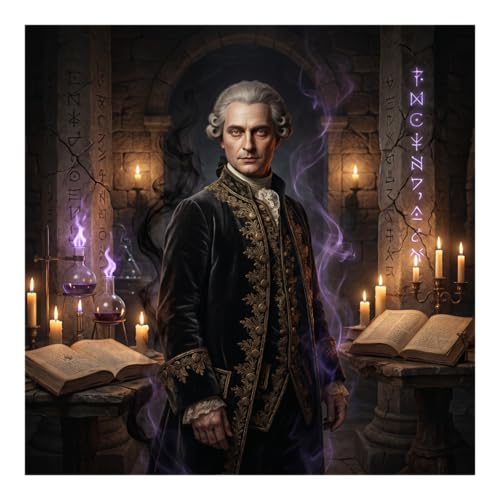
  • Saint_Germain_Alchemist_Spy_and_Occult_God
    May 21 2026

    The intellectual landscape of eighteenth-century Europe is often characterized as a battleground between the rationalism of the Enlightenment and a persistent, highly sophisticated undercurrent of romanticism, mysticism, and esotericism. At the nexus of this cultural friction stands the Count of St. Germain, a figure whose historical reality has been so thoroughly overlaid with layers of myth, occult speculation, and literary fabrication that separating the flesh-and-blood courtier from the immortal archetype remains a significant challenge.

    To the high societies of London, Paris, St. Petersburg, and the small German principalities, he was a fascinating polymath: an accomplished chemist, an exquisite violinist, a multilingual diplomat, and a highly persuasive self-promoter. To subsequent generations of occultists, starting with the nineteenth-century spiritualist movements and extending to modern New Age religions, he was transformed into an Ascended Master, a timeless guardian of ancient wisdom who allegedly bypassed the boundaries of physical mortality.

    Show More Show Less
    40 mins
  • The Mothman
    May 21 2026

    This modern iteration of folklore did not mature through generations of oral transmission; rather, it was synthesized almost overnight within a media ecosystem heavily reliant on sensationalist journalism, national wire services, and a growing interest in anomalous phenomena.

    To analyze the Mothman is to engage with what Bernard Heuvelmans termed cryptozoology—the systematic, albeit marginalized, study of hidden animals—which saw a major post-war resurgence following the publication of his landmark 1955 text, On the Track of Unknown Animals.5 Cryptids of this nature operate within a liminal space, mirroring the concept of the Wunderkammer, or early modern cabinet of curiosities.

    Show More Show Less
    23 mins