Nelson John 360 cover art

Nelson John 360

Nelson John 360

By: Nelson John
Listen for free

The world is full of fascinating stories, but they're rarely told with the depth they deserve. I'm here to fix that.

I'm Nelson John, and welcome to my show. You might know me from "Top of the Morning" at Mint/Hindustan Times .

Each episode, I take one topic and go deep. Whether it's geopolitics, innovation, the future of our planet, or simply a story that restores your faith in humanity. I don't just tell you what's happening. I explain how and why it works.

If you're curious about the world and want to understand what's really going on beneath the surface, you're in the right place.

https://www.nelsonjohn.in

Nelson John 2026
Politics & Government Social Sciences
Episodes
  • Delhi Wants More EVs. So Where Do the Dead Batteries Go?
    Jun 30 2026

    Delhi just approved its EV Policy 2026, putting thousands more electric vehicles on the road with tax waivers, scooter subsidies, and 30,000 new charging points. It's a win for clean air. But it left one question hanging, and the opposition raised it on the floor: what happens to all the batteries?

    In this episode of Nelson John 360, Nelson John follows that question somewhere unexpected. Every EV battery dies in about eight to ten years, and India already has crores of EVs on its roads. A mountain of dead batteries is coming. Most people assume nobody's worked out who handles it. They're wrong, and the real story is bigger than waste. It's about power.

    India buys 84% of its lithium-ion cells from China and leans on it for 85 to 90% of its rare earth magnets. In 2025, China showed it would weaponise that grip, slowing Indian car factories with a single export curb. EV battery recycling in India is one of the few levers India actually controls: a form of urban mining that recovers lithium, cobalt, and nickel from spent packs and feeds them back into new ones.

    Nelson John breaks down the real players like Attero and Lohum, and the brutal economics underneath: the lithium price crash, the LFP chemistry problem, and why India still recycles barely 1% of its dead batteries. He ties it to the China critical minerals chokehold, India's supply chain risk, the National Critical Mineral Mission, and energy security.

    This is a story about clean energy, geopolitics, and independence. Listen to understand why the metal inside your electric scooter matters far more than you think.

    Show More Show Less
    11 mins
  • If a Passport Isn't Proof of Citizenship, What Is? India's Document Gap Explained
    Jun 26 2026

    On 24 June 2026, India's Ministry of External Affairs said something that sounded explosive but is actually old law: an Indian passport is a travel document, not proof of citizenship.

    By design, the Passports Act lets non citizens hold one, and courts have said the same since a 2013 Bombay High Court ruling. The reason it caused panic is timing. It landed mid way through the Special Intensive Revision, a voter roll clean up that has cut a net five crore names across twelve states, with people being asked to prove they belong.

    The deeper truth it exposed: India has no single citizenship card. Most people prove citizenship through a fragile bundle of birth, parentage and old records. Aadhaar, voter ID and PAN don't count.

    The diaspora has lived this already, surrendering passports and holding OCI, which is not citizenship. The real question isn't the passport. It's who gets asked to prove they're Indian, and who can't.

    Show More Show Less
    21 mins
  • Trump and Iran Sign to End the War: The Deal, Explained
    Jun 18 2026

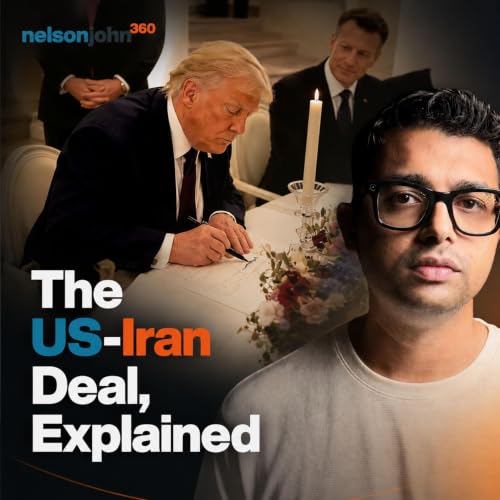
    The US-Iran war is over, signed on Wednesday night by Donald Trump and Iran's Masoud Pezeshkian over dinner at the Palace of Versailles. But what's actually inside the deal, and does it hold?

    Nelson John breaks it all down: the 60 day ceasefire, the billions in frozen Iranian money, the disputed $300 billion "rebuild Iran" fund, and the nuclear catch everyone's arguing about. Plus the part the celebration photos skip, the Strait of Hormuz, where a fifth of the world's oil flows, is still mostly shut, with around a thousand ships stranded. And why this lands straight at your doorstep: India's oil bill, the rupee, the Gulf diaspora, and the three Indian sailors killed in that strait last week. Clear, fast, and with a point of view.

    [us iran peace deal signed at versailles, trump iran deal signed over dinner, us iran memorandum of understanding explained, us iran deal indian rupee impact, trump iran deal during g7 summit 2026, what is in the us iran deal explained, us iran deal impact on india oil prices]

    #USIranDeal #StraitOfHormuz #Versailles #OilPrices #IndiaEconomy #trumpsigns

    Show More Show Less
    7 mins
adbl_web_anon_alc_button_suppression_t1
No reviews yet