• The Great Hackensack–New York City Tornado Disaster of 1895
    Jul 14 2026

    In July 1895, one of the most remarkable and least remembered tornado disasters in the history of the New York metropolitan area struck without warning. Historic Cherry Hill near modern day Hackensack and River Edge, New Jersey, was devastated as homes, businesses, farms, churches, and the railroad community were torn apart. The same day, another destructive tornado ripped through Woodhaven in what is now Queens, New York City.

    In this episode of Meteorology Matters, meteorologist Rob Jones reconstructs the disaster property by property, following the storm’s path through Cherry Hill while telling the stories of the people who lived through it. Along the way, we examine the deaths, rescues, destruction, and recovery, while exploring one of the biggest unanswered questions in American weather history: Was this one extraordinary tornado that crossed from New Jersey into New York City, or two separate tornadoes produced by the same storm system?

    Join us as we revisit one of the forgotten weather disasters that helped shape the history of the New York region.

    Show More Show Less
    39 mins
  • The Heat Wave That Changed America: How Weather Reshaped Modern Life
    Jul 13 2026

    What if one weather event quietly transformed an entire nation?

    The deadly heat wave of 1936 was far more than a record-breaking summer. It changed how Americans dressed, where they lived, how buildings were designed, and accelerated the adoption of air conditioning that would reshape cities, businesses, and everyday life for generations.

    In this episode of Meteorology Matters, we explore how extreme weather can leave lasting marks on society, not just through disasters, but through the ways people adapt. From sleeping porches and blocks of ice to modern heat domes, urban heat islands, and the future of cooling technology, this is the story of how weather quietly helped build the modern world.

    Whether you’re fascinated by meteorology, history, engineering, or simply curious about how our daily lives came to look the way they do, this episode reveals why some of the most important weather stories continue long after the forecast has ended.

    Follow meteorologist Rob Jones for more weather insights, hurricane coverage, and new episodes of Meteorology Matters.

    Show More Show Less
    34 mins
  • Can Scientists Really Steer Hurricanes?
    Jul 8 2026

    Can scientists really change the path of a hurricane or is that still science fiction?

    This episode explores one of the most fascinating questions in atmospheric science: whether humans could ever influence one of nature’s most powerful storms.

    From Project STORMFURY to modern cloud seeding research, computer modeling, and artificial intelligence, the conversation separates what is scientifically plausible from what remains theoretical, unproven, or misunderstood.

    The episode explains what cloud seeding can realistically do, why hurricanes are so difficult to modify, what recent research suggests about future possibilities, and why computer simulations should not be confused with real-world hurricane control.

    It also examines why weather-control conspiracy theories often spread after major hurricanes, heat waves, floods, and other high-impact events and how evidence-based meteorology helps separate science from misinformation.

    Whether you’re interested in hurricanes, weather modification, atmospheric science, or the future of forecasting technology, this episode looks at the real science, the limits, and the unanswered questions behind one of meteorology’s biggest ideas.

    Follow Rob Jones on Instagram, TikTok, YouTube, and Facebook for more weather content. Please like, follow, comment, rate the podcast, and share it with someone who loves weather.

    Show More Show Less
    36 mins
  • America’s 250th Nearly Melted Down: The Historic Heat Wave That Changed the Fourth of July
    Jul 5 2026

    America’s 250th birthday celebration was supposed to be one of the biggest events in the nation’s history. Instead, record-breaking heat, dangerous thunderstorms, emergency evacuations, and severe weather forced officials to cancel parades, alter major events, and protect hundreds of thousands of people from life-threatening conditions.

    Discover how a powerful heat dome sent temperatures soaring above 100°F across the Mid-Atlantic, why the heat index climbed well above 110°F, and how the atmosphere produced severe thunderstorms capable of disrupting celebrations on the National Mall just hours later.

    We also explore why extreme heat remains America’s deadliest weather hazard, how emergency managers prepared for millions of visitors, what happens to power grids, transportation systems, and infrastructure during prolonged heat waves, and the science behind the dangerous conditions that affected Washington, D.C., Maryland, Virginia, and much of the eastern United States.

    The episode also examines why weather misinformation spreads during major events, separates atmospheric science from online conspiracy theories, and explains what meteorologists actually know about weather modification.

    Finally, you’ll hear practical advice on recognizing heat exhaustion and heat stroke, protecting yourself during dangerous heat, and even how people survived summers before modern air conditioning.

    Whether you’re fascinated by meteorology, emergency management, climate, or simply want to understand one of the most remarkable weather events of the summer, this episode explains the science behind the story in a clear, balanced, and engaging conversation.

    Follow Meteorologist Rob Jones on Instagram, TikTok, YouTube, and Facebook for more weather discussions, hurricane coverage, and behind-the-scenes meteorology. If you enjoyed this episode, please follow the podcast, leave a rating and review, and share it with someone who loves weather.

    Show More Show Less
    44 mins
  • Twenty Years Later: What Scientists Got Right
    Jun 19 2026

    Twenty years after An Inconvenient Truth, how well have scientific warnings held up?

    In this episode of Meteorology Matters, we examine the lessons of the past two decades, from the recovery of the ozone layer and the decline of acid rain to growing concerns about extreme heat during the 2026 FIFA World Cup and remarkable winter warmth in Antarctica.

    We also explore a new challenge facing researchers and the public: the rise of AI-generated fake studies and the growing importance of trust in science and scientific communication.

    Join us for a thoughtful discussion about weather, environmental change, scientific integrity, artificial intelligence, and what the next twenty years may bring.

    Show More Show Less
    32 mins
  • America is Going Ocean Blind: Critical Sensors Are Being Removed
    Jun 5 2026

    Another major setback to US Ocean research policy due to the Trump Administration’s attack on science.

    The federal government is dismantling much of the Ocean Observatories Initiative, a vast network of nearly 900 deep-ocean sensors that track ocean temperatures, marine heatwaves, fisheries conditions, carbon absorption, and changes in major ocean currents.

    Supporters say the move reflects changing priorities and a more flexible research strategy. Critics warn it could leave scientists, fishermen, coastal communities, and weather researchers with fewer tools to monitor a rapidly changing ocean.

    At the same time, proposed changes to federal grantmaking could fundamentally alter how scientific research is funded in the United States, raising questions about peer review, political oversight, international collaboration, and America’s future role in global climate and ocean science.

    In this episode of Meteorology Matters, we examine what’s being removed, what’s changing, who is affected, and what the long-term implications could be for weather forecasting, climate research, marine industries, and scientific leadership worldwide.

    Show More Show Less
    26 mins
  • The Hurricane Checklist Most People Forget: How to Make Your Home Survive the Storm
    Jun 1 2026

    Hurricane season is here, but real preparation is about more than buying water and batteries.

    In this episode of Meteorology Matters, created by meteorologist Rob Jones, we look at what actually helps homes survive hurricanes: sealed roofs, protected windows, stronger garage doors, hurricane shutters, flood barriers, backup power, insurance documentation, and the overlooked steps many people forget until a storm is already approaching.

    We also explain why the “building envelope” matters, how one failed opening can lead to major structural damage, why closing interior doors can reduce pressure on a roof, and how modern mitigation standards such as FORTIFIED construction can lower risk and reduce losses.

    The episode also looks back 100 years to the devastating 1926 Great Miami Hurricane and the October 1926 Cuba Hurricane, showing why historical storms still matter today as millions of people live in hurricane-prone areas.

    Preparedness is not panic. It is planning, mitigation, and giving your family and your home the best chance before the storm arrives.

    Show More Show Less
    58 mins
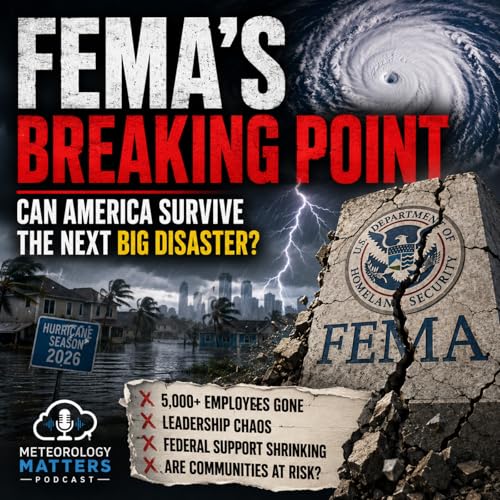
  • FEMA’s Breaking Point: Can America Survive the Next Big Disaster?
    May 29 2026

    As the 2026 hurricane season begins, FEMA faces one of the most turbulent periods in its history.

    More than 5,000 employees have left the agency since 2025. Leadership has changed repeatedly. Disaster-response staffing remains stretched, while a new federal reform plan proposes shifting more responsibility from Washington to states and local governments.

    Supporters say the changes could reduce bureaucracy and make disaster recovery more efficient. Critics warn they could leave vulnerable communities with fewer resources when major disasters strike.

    In this episode of Meteorology Matters, we examine FEMA’s readiness for the 2026 hurricane season, the agency’s workforce and leadership challenges, proposed changes to federal disaster policy, the future of flood insurance, and what these reforms could mean for hurricane-prone states like Florida and communities across America.

    As hurricanes, floods, wildfires, and other extreme weather events continue to test emergency management systems, one question looms over the season ahead:

    Is FEMA prepared for the next major disaster, or is the nation entering a new era of disaster response?

    Show More Show Less
    28 mins