• Season 1 Episode 4: The Myth of Self-Sacrifice
    Jun 15 2026

    There's a version of leadership that looks, from the outside, like extraordinary dedication.

    The leader who absorbs the pressure so the team doesn't have to. Who steps in before things go wrong, carries what others can't, and gives — consistently, quietly, without complaint — until there's very little left to give.

    It's often praised. Sometimes celebrated. And it is, beneath the surface, a form of disappearing.

    In this episode, Elizabeth challenges one of the most socially reinforced myths in modern leadership: the belief that self-sacrifice is what good leadership is made of. That absorbing more, shielding more, and giving more is the mark of a leader worth following.

    It isn't. And the cost isn't only paid by the leader.

    Elizabeth explores how over-functioning, however well-intentioned, quietly creates the conditions it was meant to prevent.

    Teams that become dependent rather than capable. Individuals who never develop confidence because they're never given the discomfort they need to grow. Cultures that mistake a leader's constant intervention for strength, when what's actually being modelled is an unsustainable relationship with responsibility.

    She draws a precise and important distinction between stewardship and overreach — between care that genuinely serves and care that quietly undermines. And she reframes boundaries not as a retreat from generosity, but as the very infrastructure that makes sustained generosity possible.

    Because the most resourced thing a leader can offer their team isn't self-erasure. It's presence. Clarity. Dignity. The steady, visible humanity of someone who leads from wholeness rather than depletion.

    That's the kind of leadership people grow inside of. And this episode shows you how to find your way back to it.

    WHAT YOU’LL DISCOVER IN THIS EPISODE:

    • 00:25 – Why leadership has been wrongly equated with martyrdom

    Why self-sacrifice feels noble, heroic, and deeply responsible even as it quietly erodes the very capacity you need to lead

    • 02:50 – The hidden cost of over-functioning

    Why the people you're trying to protect start feeling the consequences of your depletion long before you do

    • 04:27 – The fine line between stewardship and overreach

    How the line between wise intervention and unnecessary absorption becomes almost invisible over time

    • 09:00 – Why self-sacrifice creates dependent teams rather than capable ones

    Why shielding your team from discomfort and consequences keeps them small and sidelines their development

    • 11:31 – How preemptively stepping in creates dependency loops and prevents confidence from forming

    The more you step in, the less your team can stretch; the less they stretch, the more you need to step in

    • 14:10 – Why limits aren’t weakness but the foundation of sustainable, humane leadership

    Why your limits aren't a retreat from care but the very infrastructure that makes sustained care possible

    • 15:36 – A practical pause-and-breathe method to discern whether intervention is stewardship or self-sacrifice

    An experiment that interrupts the step-in reflex

    • 16:23 – A weekly rhythm to filter decisions

    The four-question filter that helps you distinguish real risk from imagined risk, irreversible consequences from recoverable ones, and moments that need your expertise from moments that need their development

    Resources

    Further Reading:

    Over‑functioning • Boundaries • Relational patterns

    The Power of Discord — Ed Tronick & Claudia Gold

    The Dance of Connection — Harriet Lerner (updated edition)

    Dare to Lead — Brené Brown

    Show More Show Less
    20 mins
  • Season 1 Episode 3: The Myth of Health as a Perk
    Jun 10 2026

    Your health was never just personal.

    It was always systemic.

    In this episode, Elizabeth dismantles one of the most quietly destructive myths in modern leadership: the idea that a leader's health is a private matter — optional, personal, and separate from the work. Something to be tended to eventually, in the margins, when the demands of leadership finally allow for it.

    They rarely do. And the cost of that belief is rarely contained to the leader who holds it.

    Elizabeth explores what happens at the organisational level when a leader treats their internal state as inconsequential — how depletion ripples outward into decisions, relationships, and the unspoken signals a team absorbs long before any words are spoken.

    She also draws on neurobiology to make the case that health isn't a lifestyle preference. It's a structural force. One that either steadies the system around you or quietly destabilises it.

    Because the leaders who shape their teams most profoundly aren't necessarily the most talented or the most experienced. They're the most regulated. The most present. The most resourced.

    When you steady yourself, you steady the system.

    That's not a wellness aspiration. That's a leadership responsibility

    WHAT YOU’LL DISCOVER IN THIS EPISODE:

    • 00:06 – Why the belief that health is optional quietly undermines leadership

    The moment a leader decides their health can wait, the whole system around them begins to feel it

    • 04:06 – Why teams respond more to what you embody than what you say

    Why leadership is relational, energetic, and systemic in ways that make health an organisational responsibility

    • 06:23 – How ignoring exhaustion leads to reactive decisions, strained relationships, and unintended signals that ripple through the system

    A leadership story on what it costs a team when a leader quietly pushes through depletion

    • 08:21 – Why organisational culture often treats health as inconvenient

    A personal account on what it feels like when a culture sends the message that your health is fine as long as it doesn't inconvenience the work

    • 12:00 – How neurobiology proves health isn’t private - it’s systemic

    How depletion and steadiness are both contagious in ways that make leadership health a structural force

    • 15:18 – Treating health as leadership infrastructure

    Why health must be treated as a leadership responsibility rather than a personal afterthought

    • 18:00 – Practical tools that shift health from afterthought to foundation

    A signal-naming experiment, a reflective question, and a weekly blueprint practice that builds health into your leadership rhythm one deliberate behavior at a time

    Further Reading:

    Interoception • Co‑regulation • Systemic health

    The Awakened Brain — Lisa Miller

    The Extended Mind — Annie Murphy Paul

    The Mind‑Gut Connection — Emeran Mayer

    The Compassionate Mind — Paul Gilbert

    The Microstress Effect — Rob Cross & Karen Dillon

    Show More Show Less
    17 mins
  • Season 1 Episode 2: The Myth of Deferral
    Jun 8 2026

    You’ve promised yourself rest after the project ends … but does it ever?

    After this project. After this quarter. After things settle.

    It feels reasonable. Even responsible. The work is real, the demands are real, and the intention to rest, eventually, feels genuine enough.

    But "later" has a way of never quite arriving.

    In this episode, Elizabeth dismantles the second myth embedded in modern leadership: the myth of deferral. The belief that health, restoration, and self-investment can be postponed until the conditions are right, and that the leader who waits will somehow arrive at that quieter season intact.

    Biology tells a different story though.

    Elizabeth explores why deferral isn't discipline, it's a slow form of self-abandonment that erodes the very capacity leadership depends on. She introduces the concept of future self continuity and what changes when you begin making decisions today on behalf of the leader you're becoming.

    She unpacks the five domains of resilience and how small, consistent actions within each one don't just accumulate, they compound.

    This episode isn't a conversation about self-care as a reward for hard work. It's a conversation about infrastructure. About the quiet, daily deposits that determine whether your leadership strengthens or diminishes over time.

    The design begins here. Not later. Now.

    WHAT YOU’LL DISCOVER IN THIS EPISODE:

    • 00:12 – The myth of deferral and how it quietly drains your leadership capacity - Why "later" is always a moving target
    • 07:17 – How future self continuity changes the way you invest in health today - How closing that gap between your future and present self changes every small decision you make about your health right now
    • 10:03 – The five domains of resilience and how micro-actions in each create compounding returns - How The Longevity Blueprint gives you a whole-system model for investing in the strength, cognition, and freedom your future self will rely on
    • 12:17 – Closing the gap between ‘I will’ and ‘I did’ - How one tiny experiment, chosen now rather than later, is enough to start closing it
    • 13:39 – Why honouring your own timeline liberates your leadership and strengthens your legacy - Why your future self is already counting on the deposits you make today

    Resources

    A few grounding touchpoints for Myth 2:

    • Leadership Longevity™ Podcast Hub — explore episodes, themes, and the philosophy behind the work.
    • The Mindful Executive (TME) — Elizabeth’s work with leaders and organisations.
    • Reflection Prompt: What am I postponing today that my future self, the one I'm in training for in the longevity blueprint, needs me to prioritize now?
    • Further Reading: The Science of Future Self Continuity — Why Leaders Who Invest in Themselves Today Lead Better Tomorrow — an exploration of compounding micro-actions, longarc capacity, and why deferral is the quietest form of self-abandonment. Available at tmegrp.com

    Show More Show Less
    16 mins
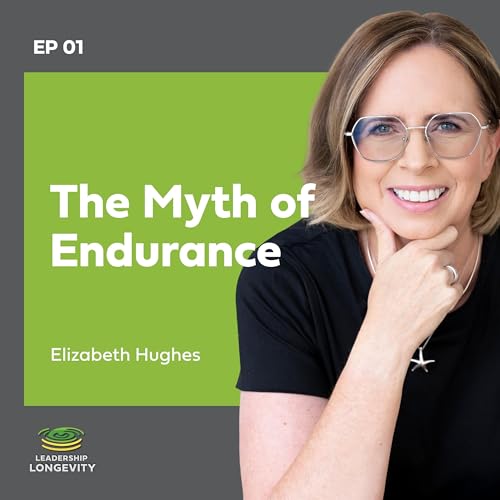
  • Season 1 Episode 1: The Myth of Endurance
    Jun 8 2026

    There’s a moment every leader knows.

    A quiet, private moment where the pressure rises and you tell yourself:

    Push a little further.

    Hold a little longer.

    You can rest on the other side.

    It feels like discipline.

    It feels like commitment.

    It feels like leadership.

    It feels like the right thing to do.

    Until the body starts telling a different story.

    In this episode, Elizabeth dismantles the first and most seductive myth in modern leadership, the myth of endurance. The belief that stamina is a strategy. That capacity is infinite. That biology will simply comply with whatever you demand of it.

    It won't.

    Elizabeth traces what actually unfolds in your nervous system when you continue to override fatigue, and why the state you've come to call functioning is not the same as being well. She draws a critical distinction between relief and recovery, explores why the pace you're modelling is quietly becoming the pace your team inherits, and asks the harder question beneath the performance: What is this pattern actually costing you?

    She also offers three practical tools you can begin using today, not to optimise harder, but to interrupt the pattern, understand it, and build something more durable in its place.

    Because leadership longevity isn't about pushing further. It's about learning to move differently, with rhythm, discernment, and a physiology that's actually resourced for the long arc.

    That's the real work. And this is where it begins.

    WHAT YOU’LL DISCOVER IN THIS EPISODE:

    • 01:31 — The most dangerous leadership myth you've been taught - The "push through it" story and why most leaders only recognise the cost after they've already paid it
    • 03:45 — The internal operating system every leader has but rarely manages - The four-event system (endurance, recovery, adaptation, and rhythm) that stabilises your biology under pressure
    • 06:10 — Why you keep overriding your body (and what it's costing you) - Functioning and being well are not the same thing
    • 09:15 — The intergenerational cost of a culture built on endurance - How the pace you model becomes the pace your team inherits
    • 11:40 — Daniel's story: the moment endurance becomes a liability - Why a holiday isn't the same as recovery and what actually needs to change
    • 13:50 — The physiology your leadership depends on (and what you're likely ignoring) - What allostatic load actually does to your memory, patience, creativity and decision making
    • 17:20 — Three tools to interrupt, understand, and rebuild your rhythm - A 60-second micro-pause experiment, a reflective question, and a weekly ecosystem practice

    Resources

    A few grounding touchpoints for Myth 1: The Myth of Endurance

    • Leadership Longevity™ Podcast Hub — explore episodes, themes, and the philosophy behind the work. (Link to Podcast webpage)
    • The Mindful Executive (TME) — Elizabeth’s work with leaders and organisations.(Link to TME Home page)

    Further Reading: Why Leaders Burn Out — And Why It's Not What You Think — an exploration of allostatic load, capacity erosion, and why rhythm is the missing infrastructure in modern leadership. Available at tmegrp.com

    Show More Show Less
    18 mins
  • Leadership Longevity Is Designed, Not Endured
    Jun 4 2026

    Leadership longevity isn’t accidental. It’s designed.

    In this opening episode of the Leadership Longevity™ Podcast, Elizabeth Hughes reframes leadership as a regenerative practice, one built on rhythm, clarity, and health as infrastructure. She speaks directly to leaders who are achieving results on the surface yet quietly sensing that the way they’ve been leading is no longer the way they want to lead.

    Rather than pushing harder or chasing faster strategies, this episode explores what actually sustains leadership over the long arc. You’ll hear why endurance collapses under modern complexity, how urgency erodes influence, and why legacy is something you live, not something you leave behind.

    This is the emotional and conceptual foundation of Season 1, an invitation to lead in a way that renews rather than depletes.

    If you’re ready to design leadership that strengthens instead of extracts, this is where the work begins.

    WHAT YOU’LL DISCOVER IN THIS EPISODE:

    • 00:00 - Regeneration over endurance - Why modern leadership strain is not a personal failing but a systemic mismatch.
    • 02:30 - The quiet erosion - How urgency, pace, and inherited expectations distort clarity and capacity.
    • 04:40 - The myths that shorten leadership careers - Endurance, deferral, health as a perk, self‑sacrifice — and the deeper patterns beneath them.
    • 08:30 - The Survival Drivers - The four inherited patterns that drain capacity, distort influence, and shorten the long arc of a career.
    • 09:42 - Why integration is where transformation happens - Why regenerative leadership is multidisciplinary by design, and why no single insight is enough.
    • 11:40 - Leadership that outlives the role - How rhythm, presence, and lived legacy reshape the long arc of influence.

    Resources

    A few grounding touchpoints as you begin Season 1:

    • Leadership Longevity™ Podcast Hub - explore episodes, themes, and the philosophy behind the work.
    • The Mindful Executive (TME) - Elizabeth’s work with leaders and organisations.

    Reflection Prompt: What part of your current leadership rhythm feels out of alignment with who you’re becoming?

    Show More Show Less
    17 mins