• Is Doug Ford in trouble?
    May 5 2026

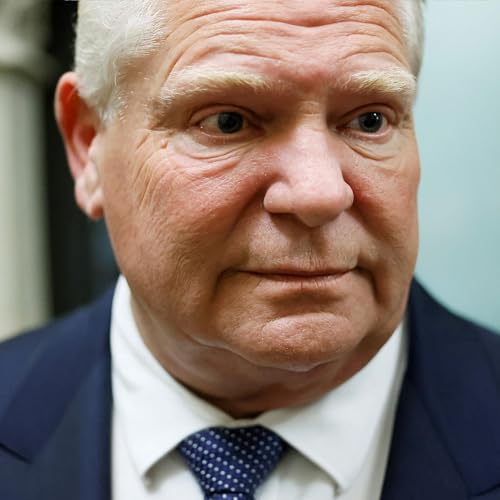
    He was “Captain Canada” last year and at one point, the most popular conservative in Canada.

    But now Ontario Premier Doug Ford’s taken a hit in the polls after a series of decisions that include the purchase and almost immediate sale of a $28.9-million private jet that his critics are calling the “gravy plane”.


    Two recent polls have seen the Ontario PCs drop enough to find themselves almost on par with the Liberals, a party that’s currently helmed by an interim leader. Doug Ford’s personal approval ratings are worse, with more Ontarians unhappy with him than not. Can he turn this around? We’re joined by Robert Benzie, Queens Park Bureau chief for The Toronto Star.


    For transcripts of Front Burner, please visit: https://www.cbc.ca/radio/frontburner/transcripts

    Show More Show Less
    30 mins
  • Elon Musk vs OpenAI
    May 4 2026

    We are entering week two of a dramatic trial that pits two of the biggest names in tech against each other: Elon Musk and Sam Altman.


    Musk is suing OpenAI, a company that he co-founded, claiming they betrayed their original mission in order to chase profits. According to him, the fate of the world is at stake.


    But OpenAI says it’s all sour grapes, and that he's just upset that they did so well after he stepped down.


    New York Times technology correspondent Mike Isaac has been covering the trial in Oakland, California. He joins us to break down the stakes of the trial, as well as what it’s taught us about the AI race.


    For transcripts of Front Burner, please visit: https://www.cbc.ca/radio/frontburner/transcripts

    Show More Show Less
    28 mins
  • Why is everything a ‘false flag’?
    May 1 2026

    Following the recent shooting connected to the White House Correspondents’ Dinner, false-flag conspiracy theories emerged almost instantly online.


    A false-flag is a covert operation designed to appear as though it was carried out by someone other than the true perpetrator.


    And the complicated thing is that false-flag operations are not just the figments of paranoid imagination. Throughout history, governments have used deception, staged attacks, and manipulated attribution to justify war, consolidate power, and shape public opinion.


    Today, we’re joined by Kathryn Olmsted, author and distinguished professor of history at University California, Davis, to discuss the history of false flag operations, conspiracy culture, and the relationship between real government deception and modern political paranoia.


    For transcripts of Front Burner, please visit: https://www.cbc.ca/radio/frontburner/transcripts

    Show More Show Less
    32 mins
  • How the petrodollar took over the world
    Apr 30 2026

    The shockwaves triggered by the U.S.-Israeli war on Iran have made clear the extent to which the global economy relies on oil, and the U.S. dollar. It’s no accident.


    So today we are going to try and understand how and why the U.S. and Saudi Arabia created this system, and how severely it’s being tested by this war. David Wight is our guest. He’s a lecturer at the University of North Carolina Greensboro and the author of Oil Money: Middle East Petrodollars and the Transformation of U.S. Empire, 1967–1988.


    For transcripts of Front Burner, please visit: https://www.cbc.ca/radio/frontburner/transcripts

    Show More Show Less
    27 mins
  • Mark Carney’s economic update
    Apr 29 2026

    Prime Minister Mark Carney’s government has delivered its spring economic update amidst an unpredictable global backdrop. It included a better-than-expected deficit figure and billions of dollars for skilled trades workers, as well as a sovereign wealth fund. Senior business correspondent Peter Armstrong breaks down what the document tells us about Canada’s finances and the Liberal government’s priorities.


    For transcripts of Front Burner, please visit: https://www.cbc.ca/radio/frontburner/transcripts

    Show More Show Less
    28 mins
  • Can surveillance pricing be stopped?
    Apr 28 2026

    For years, Jim Balsillie has been one of the loudest voices in the country to speak out about how data is being used to concentrate wealth and power, and to manipulate our behaviour.


    That’s included helping the province of Manitoba take aim at algorithmic or surveillance pricing, where businesses offer different prices based on consumers' personal data.


    As well as being the former Research In Motion co-CEO, Jim is the founder of the Canadian Shield Institute, which is a non-partisan organization that aims to build economic resilience and sovereignty in Canada.


    He joins us to talk about his efforts to fight surveillance pricing, as well as how he thinks Canada is poised to give up our digital sovereignty and more in the upcoming CUSMA talks.


    For transcripts of Front Burner, please visit: https://www.cbc.ca/radio/frontburner/transcripts

    Show More Show Less
    27 mins
  • A third attempt on Trump’s life?
    Apr 27 2026

    On Saturday night, as U.S. President Donald Trump sat on a dais in front of a room full of journalists, gunshots were heard inside the building. An armed man was taken down by Secret Service members, and the President was evacuated, unharmed.


    Paul Hunter was there, and describes what happened in that room, and what to make of what may be the third attempt on Trump’s life. Paul is CBC's senior Washington correspondent and co-host of the podcast Two Blocks from the White House.


    Find Two Blocks from the White House here.


    For transcripts of Front Burner, please visit: https://www.cbc.ca/radio/frontburner/transcripts

    Show More Show Less
    36 mins
  • Why can’t the U.S. win its wars?
    Apr 24 2026

    Nearly two months into the war on Iran one thing remains clear: Iran has secured strategic leverage that before this war began, seemed unlikely.


    And it's left many asking why the United States’ military - the most powerful in the history of the world — so often finds itself unable to win wars or satisfy its strategic objectives?


    All kinds of military analysts and historians believe the U.S. has lost or failed to meet its strategic objectives in virtually every war it has participated in since 1945. This includes the Korean War, the Vietnam War and the wars in Afghanistan and Iraq.


    Today, we’re joined by Seth Harp, journalist, and author of the bestselling book ‘The Fort Brag Cartel’. Seth served one tour in Iraq as a member of the U.S. military, and previously worked as the assistant Attorney General for the state of Texas.

    Show More Show Less
    31 mins