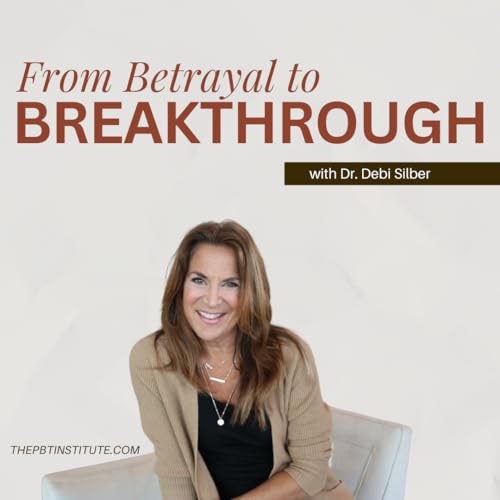
• 472: Behind the Scenes with Dr. Debi — A Surprise Interview with My Daughter Camryn
    May 4 2026
    What happens when you hand the microphone to your daughter and tell her to ask whatever she wants — no prep, no filters? That's exactly what this episode is. My daughter Camryn sat down with me for a conversation I didn't see coming, asking questions designed to draw out the side of Dr. Debi that doesn't always show up in research discussions or keynote stages — the personal, the raw, the real. From what betrayal physically felt like in my body before I had any language for it, to what Stage Three actually looked like in our home, to what full transformation feels like at 60 with a grandchild on the way — this one goes places I rarely go publicly. If you've ever wondered what the behind-the-scenes life of someone who built the world's leading organization for betrayal recovery research, education and transformation looks like, this episode is for you. In This Episode: Why Dr. Debi prioritizes being the same person everywhere — and what that has to do with a world of shattered trust What betrayal felt like physically (hint: heartbreak is very real, and yoga almost broke her) What "functioning but not healed" — Stage Three — actually looked like in daily life The beliefs about betrayal she had to let go of that she never expected to question Her biggest fear about what her children would take from watching her go through it Why rebuilding with someone is harder than walking away — and what she learned from doing it What "wise trust" looks like now, and how it's different from before What Stage Five feels like in real life — 40 people in formal wear jumping in the pool, coffee time at 6am, and not caring what anyone thinks What she would say to herself on D-Day, the day everything came out Camryn's reflection on watching her mother not just rebuild, but transform — and what that gave the whole family A Note from Dr. Debi: I didn't know the questions. I didn't prepare. And that was the whole point. Camryn wanted to pull out the heart — not the researcher, not the speaker — just me. I think she did. I hope something in this conversation reaches you wherever you are in your journey. And if you're in the depths of it right now: hard now, easy later. You're so much stronger than you think. Resources Mentioned: Trust Again by Dr. Debi Silber The Five Stages of Betrayal Recovery™ From Betrayal to Breakthrough Podcast Connect with Dr. Debi: Website: thepbtinstitute.com Instagram: @debisilber If this episode moved you, share it with someone who needs it.
    Show More Show Less
    21 mins
  • 471: How to Be a Friend in an Unfriendly World
    Apr 27 2026
    What does it actually take to be a good friend — to others and to yourself? In this rich conversation, Dr. Debi sits down with award-winning filmmaker, Columbia University faculty member, and author Barnet Bain to explore the surprising truth about why so many of us struggle in friendships: we never learned how. Drawing from his course on relationships taught at Columbia and his new book How to Be a Friend in an Unfriendly World, Barnet unpacks the invisible programming we carry from childhood, the neuroscience of emotional imprinting, and the practical steps toward becoming someone who can truly show up — for others and for yourself. Guest: Barnet Bain Barnet Bain is an award-winning Hollywood filmmaker, author, and educator who served on the faculty at Columbia University, where he taught a master's-level course called Artistry and Personal Spirituality — a deeply relational and psychological exploration of how we connect with others. His work spans film, writing, and teaching, all rooted in a lifelong inquiry into what it means to be in authentic relationship. 📖 Book: How to Be a Friend in an Unfriendly World — available in bookstores and online, including Amazon 🌐 Website: www.barnetbain.com What You'll Hear in This Episode Why no one actually taught us how to be a friend We learned to say please and thank you. We learned to compete and succeed. But nobody ever sat us down and said: here's what to do when feelings are hurt, here'show to stay connected when things are awkward, here's how to not quietly drift apart from people you love. Those foundational relational skills were simply never taught. The "hand-me-down" beliefs running your relationships From infancy through school and beyond, we absorb beliefs, opinions, and emotional patterns — not through deliberate instruction, but by osmosis. Most of us have never questioned whether these beliefs are actually true or originally ours. Barnet describes the startling realization that one of his first original thoughts was simply: has any thought I've ever had actually been my own? Molecules of Emotion and in-utero imprinting Inspired by Dr. Candace Pert's groundbreaking work, Barnet explains how emotional patterns can be imprinted before birth. A mother's inner emotional life — her fears, her relationship to the father, her feelings about becoming a parent — all have biochemical correlates that are shared with her unborn child. Add to that the research on generational trauma (the famous cherry blossom/mouse study gets a mention), and it becomes clear: we are carrying far more than our own story. State-bound experiences: why we react from the past, not the present One of the most compelling concepts in this episode. A state-bound experience is when a present-day stimulus — a song, a smell, a tone of voice — instantly calls up an emotional state from long ago, triggering an old response in a new situation. Most of our reactions to difficult moments in relationships aren't really about now — they're old programs running on autopilot. The sunburn analogy When you have a sunburn and someone slaps you on the back, your reaction isn't really about them — it's about the unhealed wound. The same is true emotionally. An outsized reaction to something someone says or does is almost always a signal: there's a sunburn here that hasn't healed. The path forward isn't to blame the person who touched it — it's to tend to the wound. Reactions vs. responses A reaction is automatic, coming from the sunburn. A response is what becomes possible when you slow down enough to recognize: this isn't about now. That pause — that moment of awareness — is where choice enters. You can't be a better friend to others than you are to yourself This one lands differently when you hear it in the context of betrayal healing. Many of us have been great friends to others while running a brutal inner monologue toward ourselves. That kind of friendship isn't sustainable — and it often has less to do with love and more to do with trying to feel worthy. Real friendship starts inside. The ingredients of genuine friendship Safety first — not bubble wrap, but the kind of safety where vulnerability isn't weaponized. Can your friend say something honest and messy about you without you flinching, deflecting, or lashing out? That's a growth edge worth paying attention to. Consistency over intensity — friendships fade when left to convenience. Like a rose garden, they require regular tending. A simple text: "Thinking of you — no reply needed." Undivided presence — put down the device. Look someone in the eye. Be with them. Your presence, undistracted, is one of the greatest gifts you can offer another human being. Making friends as adults It's harder — not because people are less friendly, but because the organic conditions that once created connection (same classroom, same playground...
    Show More Show Less
    38 mins
  • 470: The Wall That Protected You Is Now Your Prison
    Apr 20 2026
    TRIGGER WARNING: CHILDHOOD SEXUAL ABUSE In this powerful and important episode, Dr. Debi sits down with Chris Yadon, Executive Director of Saprea, a nonprofit dedicated to the prevention of childhood sexual abuse (CSA) and healing for survivors. Chris shares his own journey — growing up amid instability, learning to emotionally numb as a child — and how that personal experience became the foundation for his professional mission at Saprea. Together, Dr. Debi and Chris explore why childhood sexual abuse is such a uniquely devastating betrayal: in 80% of cases, the perpetrator is someone the child knows and trusts. They unpack the psychology of trauma bonding, betrayal blindness, and why survivors often don't recognize the abuse as abnormal until young adulthood. Chris explains the three forces that keep CSA under-reported — shame, trauma bonding, and perpetrator threats — and why these silencers persist well into adulthood. They also discuss the lasting impacts of unhealed childhood sexual abuse, including sobering statistics: 85% of survivors who don't address their trauma will develop a mental health disorder by age 30, and survivors are three times more likely to attempt suicide than the general population. From substance use to eating disorders, anxiety to depression, the cost of not healing is profound — and it shows up at work, in relationships, and in every corner of life. Chris shares Saprea's prevention model, the role parents and caregivers play in reducing risk on both sides, and how healing can begin at any age. He closes with a beautiful, hope-filled story of Kaya Noah — a survivor whose emotional walls came down in a snowfall — and three memorable takeaways about connection, community, and courage. If you or someone you love is a survivor, this episode carries a clear and compassionate message: healing is possible. And the resources are free. 🔗 Learn more: saprea.org 📌 Find Chris on LinkedIn or Substack: search "Yadon" Dr. Debi sits down with Chris Yadon of Saprea to explore childhood sexual abuse — what makes it so psychologically damaging, why it stays hidden, how it shows up in adult relationships and the workplace, and most importantly, how healing is possible at any age.
    Show More Show Less
    33 mins
  • 469: What Do You Want to Be When You Grow Up?
    Apr 13 2026
    In this reflective solo episode, Dr. Debi Silber shares an unexpected gift that came from a two-week battle with pneumonia — the forced stillness to ask herself one of life's most enduring questions: What do you want to be when you grow up? With her daughter's wedding just days away, Dr. Debi opens up about how illness slowed her down enough to take stock of what she's outgrown, what she's still settling for, and what she truly wants in this season of life. The result is a warm, honest, and deeply practical conversation about becoming more intentional — with your time, your energy, your relationships, and yourself. In This Episode, You'll Hear: Why the question "What do you want to be when you grow up?" deserves a second (and third) look — at every age What a recent unprepared interview guest taught Dr. Debi about standards and saying no The "Sit in the Seat" game Dr. Debi played with her family — and what it revealed about how she actually shows up The yes/no confusion that keeps so many of us stuck — and how to start untangling it How to use your body as a meter for who and what is truly good for you The "cake ingredients" framework: what you're putting into your life, and why the outcome makes perfect sense Why we become more of whatever we already are as we age — and why that's both a warning and an invitation Reflection Questions from This Episode: What have you outgrown? What are you still settling for? What do you want your life to look, feel, and sound like now? What are you saying yes to — and what does that force you to say no to? If your highest and best self were watching, what would she say? Key Insight: "It starts with awareness. The next step is action." Connect with Dr. Debi Silber: 🌐 thepbtinstitute.com 📲 Follow on social: @DebiSilber 🎙️ Subscribe to From Betrayal to Breakthrough wherever you listen to podcasts If this episode resonated with you, Dr. Debi would love to hear from you — what do YOU want to become more of as you grow?
    Show More Show Less
    20 mins
  • 468: From Stuckness to Self-Love: A Journey Through the Stages
    Apr 6 2026
    In this deeply personal episode, Dr. Debi Silber is joined by her daughter Camryn for a candid, behind-the-scenes conversation about what it really looks like to get stuck in Stage Three — not because of a betrayal by someone else, but through our own patterns, thoughts, and avoidance. Camryn's story is one of extraordinary intelligence, world travel, and deep self-awareness ultimately leading to the most important journey of all: inward. If you've ever wondered what Stage Three looks and feels like from the inside — or suspected that your coping strategies might actually be keeping you stuck — this episode is for you. Meet Camryn Holds a Master's degree with a background in psychology Multilingual and a seasoned world traveler Deep empath with a gift for feeling collective emotion Now living in Asia — a move born from genuine inner clarity, not escape Camryn has always been the kind of person who sees the world differently — comfortable in spaces of authenticity (nature, animals, children, the elderly) and deeply uncomfortable with the masks and performance of social life. As a teenager, she deleted social media entirely because of how it made her feel. That instinct, long before it was a cultural conversation, tells you everything about who she is. Key Themes & Takeaways What Stage Three Really Looks Like Stage Three — that place of surviving but not thriving — doesn't always look like suffering from the outside. Sometimes it looks like adventure. Camryn's version of Stage Three involved living in different countries, absorbing languages and cultures, sleeping in hostels, spending every dollar on experiences. From the outside: impressive. From the inside: a beautifully camouflaged method of avoiding herself. Dr. Debi draws a powerful parallel: just as some people numb with TV, alcohol, or overwork (all things that can look productive), Camryn's distraction was world travel — something that genuinely fed her AND kept her from staying still long enough to look inward. The Belief That Starts It All Dr. Debi shares one of her most-used teaching examples: a little boy with exciting news, shushed by his mother on the phone. In that moment, he might decide: "I don't matter." From there, everything confirms it — the car that cuts him off, the door that closes in his face. That core belief shapes who he dates, what he accepts, what he tolerates. The takeaway: we all carry a story. The work is finding out what story we've been telling ourselves — and whether it's true. Escaping Yourself (And Why It Doesn't Work) No matter where you go, you take your thoughts with you. Camryn describes the experience of arriving somewhere new — forced to think differently because the environment demanded it — and then slowly, inevitably, watching the same unhealed patterns creep back in. The breakthrough moment came before a planned move to New Zealand. A quiet, honest question: What do you think New Zealand is going to do for you? The answer was nothing. And that nothing was everything. The New Zealand Moment: Recognizing the Pattern This is the kind of moment that changes things. Not dramatic. Not loud. Just a pause, a look between mother and daughter, and a recognition that the pattern had been named. That's the beginning of Stage Four — when the fog lifts just enough to see what's been happening. Fear vs. Intuition: How to Tell the Difference One of the most practical and powerful parts of this conversation: how do you know if a decision is coming from your gut or from your fear? Camryn shares her process — sitting with a decision, asking whether the pull is expansive or constricting, whether it comes from the head (noisy, arguing, rationalizing) or something quieter and steadier underneath. The mind can convince you of anything. Intuition doesn't need to argue. She also shares the question she comes back to when facing a big decision: What would my oldest self have wanted? That question cuts through the noise of other people's opinions, social pressure, and fear. Honoring Others' Opinions — Without Being Ruled by Them When Camryn decided to move across the world from a close, loving family, there were feelings. Dr. Debi shares honestly that it wasn't "don't go" — it was "we'll miss you." And Camryn learned to hold that with love, express gratitude for the input, take her time, and then follow her own inner compass anyway. This is self-love in action. Not selfishness. Knowing yourself well enough to trust what you know. Being an Empath: Gift and Challenge Camryn is a deep empath — someone who doesn't just sympathize but actually feels the emotional energy of people around her, including collective pain. This explains so much: her comfort with children and animals (no judgment, no masks), her discomfort with performative social ...
    Show More Show Less
    40 mins
  • 467: Healing Betrayal Through the Subconscious Mind
    Mar 30 2026
    From Betrayal to Breakthrough with Dr. Debi Silber | Guest: Peter McLaughlin About Peter McLaughlin Peter McLaughlin is a certified hypnotherapist and founder of Blue Sky Hypnosis. After being diagnosed simultaneously with Lyme disease and leukemia 23 years ago — and given just 10 years to live — Peter embarked on a profound healing journey that led him from Wall Street and a 50-person security company in Westchester, New York, into the world of mind-body medicine and hypnotherapy. Trained through a program founded by a former paramedic and focused on the medical applications of hypnosis, Peter also served as a volunteer firefighter and EMT, giving him a unique frontline perspective on trauma, shock, and the human response to crisis. Today he helps clients heal from emotional trauma — including infidelity, betrayal, and abuse — using hypnotherapy, havening, and subconscious reprogramming. Episode Overview In this episode, Dr. Debi sits down with Peter McLaughlin to explore the profound and often hidden role the subconscious mind plays in betrayal recovery. Peter shares his remarkable personal story of survival, and then dives deep into the tools and techniques — including hypnotherapy, the pendulum, the sway test, havening, and hypnotic regression — that can help betrayal survivors release the trauma stored in the body, update the subconscious mind, and finally break free from the cycle of chronic stress and pain. Key Topics Discussed Peter's life-altering dual diagnosis of Lyme disease and leukemia — and the journey it sparked Why the body is a feedback mechanism and how it signals unresolved trauma The subconscious mind, the autonomic nervous system, and the "safe vs. dangerous" classification system How betrayal gets lodged in the subconscious with no concept of time — and why healing requires updating that The power of epigenetics: how chronic stress upregulates dangerous genes, and how healing can reverse that What hypnotherapy is and how it differs from what most people imagine Havening: a rapid, EMDR-adjacent technique for releasing trauma — and when it doesn't work Hypnotic regression: going back to the moment of trauma to reprocess, reframe, and re-heal Working with guilt and shame as the root cause of blocked healing The pendulum and the sway test as tools for accessing subconscious wisdom How every major decision is ultimately emotional — and what that means for recovery The spiritual dimension of healing: trauma as a wake-up call, not a life sentence What it looks and feels like when you've truly healed: the body stops being hijacked Memorable Quotes "The diagnosis of leukemia wasn't the title of the book of my life. It was a chapter in there." — Peter McLaughlin "Every single decision we make is ultimately an emotional decision — and then our conscious mind steps in to justify it. The conscious mind is basically like a lawyer." — Peter McLaughlin "The subconscious mind has no concept of time. It could have happened 30 years ago and it's still treating it like a clear and present danger." — Peter McLaughlin "Toxins don't just take a physical form. They also take an energetic or emotional form. When you suffer a trauma, it gets lodged within you and begins exerting its effects." — Peter McLaughlin "You are not broken. You are already magnificence, endowed by God with a magnificence inside of you. None of this is a litmus test of your worth." — Peter McLaughlin "If I didn't go through my betrayals, I never would have entered the PhD program. The five stages would never have been discovered. That's trauma well served." — Dr. Debi Silber Key Concepts Explained Havening A therapeutic technique similar to EMDR that uses gentle touch on specific areas of the body to help release trauma stored in the nervous system. Peter finds it highly effective and fast-acting — but notes it doesn't work when a client is carrying unresolved guilt or shame, which blocks the subconscious from accepting relief. Hypnotic Regression A technique in which the therapist guides the client back — hypnotically — to the original moment of trauma. From there, the client can reprocess the event, release guilt, and even "negotiate" with the younger part of themselves still holding the pain. Often, an adult client works with their own younger self to provide the wisdom, protection, and reasoning that wasn'tavailable at the time. The Pendulum & The Sway Test Both are ideomotor tools — ways of accessing the body's subconscious signals. A pendulum amplifies micro-movements in the hand to indicate yes/no responses. The sway test involves standing and noticing whether your body leans forward (toward something safe or true) or backward (away from something negative or false). These tools ...
    Show More Show Less
    32 mins
  • 466: Turning 60: What Six Decades Taught Me About Betrayal, Life & Becoming
    Mar 23 2026
    This is a milestone episode — Dr. Debi is celebrating her 60th birthday, and she's marking the occasion by sharing six of her greatest life lessons, one for each decade. Whether you're in the thick of healing from betrayal or simply looking for some wisdom to carry you forward, these lessons are deeply personal, hard-won, and universally relatable. What You'll Hear in This Episode: Lesson 1: Hard Now, Easy Later (or Easy Now, Hard Later — Take Your Pick) The philosophy Dr. Debi has lived and taught for 34+ years. Every choice falls into one of these two categories. Choosing the hard path now — whether it's healing, setting new boundaries, or making difficult changes — creates the ease later. Skipping it just means carrying the weight longer. Lesson 2: Trust Your Gut — It Never Lies From founding the PBT Institute to going back for her PhD at 50 to knowing her family wasn't complete, Dr. Debi's biggest leaps of faith have all followed her intuition. People may think you're crazy. Trust the knowing anyway. Lesson 3: Fear of the Unknown vs. Shoulda, Coulda, Woulda Dr. Debi has trained herself to find the regret that stings less — and for her, that's always trying something and failing over never trying at all. Life is short. Her mom passed at 57, and this year marks the third year Dr. Debi has outlived her. That puts everything in perspective. Lesson 4: Health Is Everything This is the only body you have. Dr. Debi shares her long-standing commitment to movement, nutrition, sleep, meaningful relationships, and sun — and gets real about the one area she's still working on: stress and rumination. Progress, not perfection. Lesson 5: Integrity Doing the right thing even when no one's looking. It makes life simpler — fewer lies to track, fewer masks to wear, and the deep peace of knowing your word means something. As Dr. Debi puts it: 100% is easier than 99%. Lesson 6: Be a Lifelong Learner — Try Things On If you see something you admire in someone else, try it. If it fits, make it yours. If it doesn't (like "Deborah"), drop it with zero guilt. Dr. Debi shares how she became a hugger and learned to make people feel like the only person in the room — both borrowed from people she deeply admired. Bonus Lesson: Stop Being So Hard on Yourself Be your own best friend. Your best is good enough. And if you find yourself doing the same frustrating things you've always done? Simply adorable. (She means it.) Mentioned in This Episode: UNSTUCK: The Practitioner's Guide to Moving Betrayal Clients from Survival to Transformation — Dr. Debi's newest book The PBT (Post Betrayal Transformation) Institute The PBT Certified Coach/Practitioner Program The Five Stages from Betrayal to Breakthrough™ National Forgiveness Day — September 1 Dr. Debi's two TEDx talks (combined 2M+ views) The From Betrayal to Breakthrough podcast (460+ episodes) Connect with Dr. Debi: Website: thepbtinstitute.com Instagram, TikTok, LinkedIn: @debisilber Loved this episode? Share it with someone who needs it, and let Dr. Debi know which lesson resonated most — she'd genuinely love to hear from you. Dr. Debi Silber celebrates 60 with six hard-won life lessons — one per decade — on intuition, integrity, health, fear, lifelong learning, and why hard now always beats easy later.
    Show More Show Less
    37 mins
  • 465: From Tragedy to Transformation — Jarrod Barakett's Story of Resilience, Healing & the Power of Frequency
    Mar 16 2026
    What happens when life keeps knocking you down — job loss, divorce, the death of a child, a failing business, a spinal crisis — and you keep getting back up anyway? In this powerful episode, Dr. Debi sits down with Jarrod Barakett , President of Light Systems, to explore one of the most remarkable resilience stories you'll ever hear. Jarrod Barakett's journey is a masterclass in accountability, forward-focused thinking, and the healing power of frequency — and his message will stay with you long after the episode ends. About Jarrod Barakett  Jarrod Barakat is the President of Light Systems, a global wellness technology company with centers in dozens of countries worldwide. Jarrod has rebuilt his life multiple times through tragedy, betrayal, and loss. He's a passionate advocate for personal accountability, intentional living, and the body's innate capacity to heal. What You'll Hear in This Episode How a jealous boss ended Jarrod's 30-year career in golf — and what he did the very next morning that set the tone for everything that followed Why Jarrod refused to ask "why me?" and instead asked "what's next?" — and the visualization practice his father taught him at age 8 that made this possible The devastating loss of his 12-year-old daughter in a boating accident in 2018, and how he found the will to keep going How a business partner's addiction cost Jarrod what was meant to be his retirement — and why he still refuses to see himself as a victim The spinal crisis that left him facing potential paralysis, and the technology that helped him return to the gym at week 10 (when doctors said wait six months) Why Jarrod tried three therapists and found that his support network of close friends and family served him better — and what that teaches us about finding the right healing path for you The concept of personal accountability as a healing tool: how Jarrod came to understand that the frequency we put out shapes everything around us Key Takeaways Betrayal doesn't have to define your trajectory. Jarrod was fired by a jealous boss after a 30-year career. His response: shower, get dressed, go to the "office" — even when the office was an unfinished basement. He never stopped showing up. Forward focus is a decision. The lesson Jarrod taught his daughter — and lives himself — is to stop thinking about what was and start thinking about what will be. It sounds simple. It isn't. It's a daily, intentional choice. Grief doesn't have a timeline, but responsibility doesn't pause. After losing his daughter, Jarrod returned to work within two weeks — not because he was healed, but because his family needed him. He shares this honestly, without pretending it was the right call, but with deep insight into what kept him moving. Your support system is everything. When tragedy strikes, the people you've invested in over a lifetime show up. Fifty friends flew in from Montreal and Boston for his daughter's funeral. That network was decades in the making. You are 100% accountable — and that's actually empowering. Jarrod's most powerful insight: if you are fully accountable for every outcome in your life, then you are also fully capable of changing your future. The power is yours. The body responds to frequency. After emergency spinal surgery, Jarrod discovered Light Systems technology — and went from excruciating post-surgical pain to training in the gym at week 10. The body knows how to heal when we give it what it needs. Resources & Links Find Jarrod on Instagram: @ JarrodBarakett  Learn more about Light Systems technology and find a center near you: lightsystems.com If This Episode Resonated With You... If you've experienced betrayal — whether by a person, a business partner, or life itself — and you're wondering how to find your way through, this conversation is proof that the human spirit is more resilient than we imagine. Share this episode with someone who needs it today. When life delivers blow after blow — job loss, divorce, the death of a child, business betrayal, spinal surgery — how do you keep getting back up? Jarrod Barakett shares his raw, remarkable story of resilience, accountability, and healing through the power of frequency and forward-focused thinking.
    Show More Show Less
    31 mins