Don DeLillo Should Win the Nobel Prize cover art

Don DeLillo Should Win the Nobel Prize

Don DeLillo Should Win the Nobel Prize

By: Jeffrey Severs & Michael Streit
Listen for free

About this listen

With episodes in which two devoted readers (Jeffrey Severs and Michael Streit) unpack his deadpan, hilarious, and disturbing works one by one, DDSWTNP is dedicated to the idea that Don DeLillo, the greatest of living writers, deserves every serious reader’s attention. Contact: ddswtnp@gmail.com. @delillopodcast. **Support our work and our trip to DeLillo's archive**: https://www.buymeacoffee.com/delillopodcast Art Literary History & Criticism
Episodes
  • Episode 35: "Creation"
    Apr 26 2026

    Anticipating a summer to be spent exploring Underworld, DDSWTNP in Episode 35 take a small detour to a DeLillo short story, “Creation,” which distills DeLillo’s omnipresent motifs of Romanticism and Christian mythos, transports literal and figurative, and disillusionment with the maintenance of Edenic experience — perhaps especially for the American tourist trying to escape from, rather than into, their vacation world. This 1979 story of infidelity, manipulation, and fantasy depicts repeated journeys to a small, jammed Caribbean airport that draw thoughts about godliness, meaning, and mortal fear from an unnamed narrator who has the impulse to write but perhaps not the skills and honed perception. In “Creation” we find many unexpected things: stirring parallels to the space orbits of “Human Moments in World War III”; a precursor to the voice of James Axton to emerge amid Mediterranean islands three years later; and of course new turns on the key DeLillo topos of plane travel and the contingencies of leaving the earth for the sky. Elements of journeys in Americana, Mao II, Cosmopolis, and Valparaiso come up, and we conclude that Rupert the cab driver may be the hero of this tale, or the figure who understands these affairs the best. We give listeners quite a few reasons to read or re-read this under-appreciated story that DeLillo would later choose to place first in The Angel Esmeralda: Nine Stories (2011).


    The cover image incorporates part of Where Do We Come From? What Are We? Where Are We Going? (1897-98) by Paul Gauguin, who seems the likely reference point when the narrator of “Creation” says of his canceled seat on a flight out, “I’ll marry a native woman and learn how to paint.”

    Show More Show Less
    1 hr and 24 mins
  • Episode 34: An Interview with Tom LeClair
    Mar 11 2026
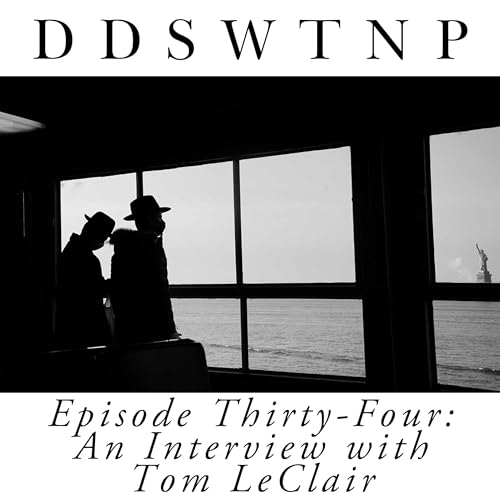
    In Episode 34 DDSWTNP sit down for a revelatory talk with Tom LeClair, a founding critic in the study of DeLillo, his longtime friend and liaison to the literary world, and a figure who has both written fiction shaped by DeLillo’s and (he suggests) seen his own stories turned into scenes and dialogue by DeLillo himself. We get into LeClair’s relationship with DeLillo going back more than forty years, starting from the time the author sent him a copy of Ratner’s Star and proceeding to a 1979 interview in Athens that illuminated a then rather reclusive and secretive writer, including the story behind a card DeLillo handed out in those years reading “I don’t want to talk about it.” We also ask LeClair questions about his many readings of DeLillo’s and others’ works over the years, starting from his major books In the Loop: Don DeLillo and the Systems Novel (1987) and The Art of Excess: Mastery in Contemporary American Fiction (1989), studies that initiated LeClair’s career-long examination of encyclopedic works that form categories of “systext,” “monsterpiece,” and others he has defined in his many major magazine and newspaper reviews and in his current substack. What does LeClair make of the many mentions of “systems” in Underworld? What does a line from Point Omega suggest to him about the possibility someday of a DeLillo biography? What does LeClair mean when he calls DeLillo a thoroughly “intuitive” writer and an artist obsessed his whole life with embodiment, birth, death, and fear? Is “mystery” the right word for what drives DeLillo’s narrative seeking, and is Catholicism a useful lens? What to make of the ending of Zero K? Why did DeLillo want to visit Beirut with LeClair? And what do these two talk about when they have lunch together? The interview also gets into depth on the many comparisons LeClair sees with his own fiction, its set of Kierkegaardian maneuvers through the Greece-based world of basketball player Michael Keever, the hero of Passing Off (1996) who begins for LeClair a series of examinations of games, terrorism, and some familiar DeLillo territory that extends through the four other Passing novels that LeClair has published in the thirty years since. Cover photograph by Kinga Owczennikow. A native of Poland, Kinga Owczennikow is currently based in New York City. She holds a BA (Hons) in Photography from the University for the Creative Arts in the UK. Kinga is an Associate of the Royal Photographic Society, a member of the Center for Photographic Art in Carmel and an exhibiting member of the Soho Photo Gallery in New York City. Kinga had a solo exhibition “The secret paths of Hong Kong” at the Asia and Pacific Museum in Warsaw, in 2011. Her photographic work has also been exhibited internationally in group shows. Her first photobook "Framing the World" was published by Ephemere in Tokyo, in 2025. Texts by Tom LeClair and others discussed in this episode: “Don DeLillo: The Word, The Image, The Gun.” BBC, 1991. https://www.imdb.com/title/tt4029096/ Amy Hungerford, “Don DeLillo’s Latin Mass.” Contemporary Literature 47.3 (Autumn 2006): 343-380. Tom LeClair and Larry McCaffery, eds. Anything Can Happen: Interviews with Contemporary American Novelists. U. of Illinois P., 1983. Tom LeClair. In the Loop: Don DeLillo and the Systems Novel. U. of Illinois P., 1987. ---. The Art of Excess: Mastery in Contemporary American Fiction.U. of Illinois P., 1989. ---. “Me and Mao II” (1993). https://perival.com/delillo/meandmaoii.html ---. Passing Off. Permanent Press, 1996. ---. “An Under-history of Mid-Century America” (review of Underworld). The Atlantic, October 1997. ---. “Two On One: Writing a Basketball Novel.” In What to Read (and Not): Essays and Reviews. Dzanc Books, 2014. ---. “Serious But Not Dangerous Don DeLillo” (review of The Silence). American Book Review 42.4 (May/June 2021): 10-11. —-. Harpooning Donald Trump: A Novelist’s Essays. Mediacs, 2017. ---. Passing Again. 2022. Tom LeClair’s Substack: https://tleclair.substack.com/ Vince Passaro, “Dangerous Don DeLillo.” New York Times Magazine, May 19, 1991. https://www.nytimes.com/1991/05/19/magazine/dangerous-don-delillo.html Lawrence Weschler, Mr. Wilson’s Cabinet of Wonder: Pronged Ants, Horned Humans, Mice on Toast, and Other Marvels of Jurassic Technology. Vintage, 1995.
    Show More Show Less
    1 hr and 48 mins
  • Episode 33: Mao II
    Feb 2 2026

    “Here they come, marching into American sunlight.” In Episode 33, DDSWTNP follow Mao II from this opening line into a chilling view of a mass Moonie wedding at Yankee Stadium, and on into the story of reclusive novelist Bill Gray, whose work, maybe, has a chance of deprogramming the mind and language of Karen Janney, one of the participants in that wedding – but maybe not, given the totalizing dominance by images that this novel documents. Our conversation delves into the several rich dialogues Mao II is known for, especially that about (quoting Bill) the “curious knot that binds novelists and terrorists,” the differing attempts by writers and bomb-makers to “alter the inner life of the culture” and “make raids on human consciousness” that DeLillo juxtaposes in this novel, which follows the writer from his cloying “bunker” to London, Athens, and (almost) Lebanon, while also taking in scenes from Iran, China, and the homeless encampments of lower Manhattan. Throughout we discuss the many followers of and sequels to Mao and Maoism DeLillo analyzes, all the ways his characters foolishly seek, outside the values of deep reading and the novel, scenes of “total vision” and messianic “total being,” the “lightning-lit” language of information and the terrorist’s mastery of “the language of being noticed.” We examine in detail as well the effects of Andy Warhol’s work as DeLillo sees it; what it means that readers never learn much at all about the content of Bill’s famous novels; the commonalities he has with Rushdie, Salinger, Pynchon, and DeLillo himself; and why terrorist go-between George Haddad loves word processors so much. We also have a lot to say about the ailing, injured body and spirit of Bill Gray, as well as the simplicity of spoons and what they might teach us about objects and art. Mao II is a book that, as we say in the episode, sums up much of the DeLillo that came before it, lays the groundwork for the masterpiece to come, and contains so many of what have come to seem over the years since 1991 (and over the run of our episodes) the foundational DeLillo ideas and questions, especially ones about politics, violence, and images. Hope you’ll have a listen and, if moved, tell us what you think!

    Texts referred to in this episode:

    David Cowart, Don DeLillo: The Physics of Language. Athens: U. of Georgia P., 2002.

    Mao II is a sort of rest-and-motion book, to invent a category. The first half of the book could have been called ‘The Book,’ Bill Gray talking about his book, piling up manuscript pages, living in a house that operates as a kind of filing cabinet for his work and all the other work it engenders. And the second half of the book could have been called ‘The World.’ Here, Bill escapes his book and enters the world. It turns out to be the world of political violence . . . I was nearly finished with the first half of the book before I realized how the second half ought to be shaped. I was writing blind . . .” –“Don DeLillo: The Art of Fiction CXXXV,” The Paris Review 128 (1993): 274-306. Interview by Adam Begley.

    “I called him Bill Gray just as a provisional name,” DeLillo says. “I used to say to friends, 'I want to change my name to Bill Gray and disappear.’ I've been saying it for 10 years. But he began to fit himself into the name, and I decided to leave it.” –Vince Passaro, “Dangerous Don DeLillo,” New York Times Magazine, May 19, 1991 (https://www.nytimes.com/1991/05/19/magazine/dangerous-don-delillo.html)

    Mark Osteen, American Magic and Dread: Don DeLillo’s Dialogue with Culture. Philadelphia: U. of Pennsylvania P., 2000.

    Sources of interlude clips from Warhol and Moon:

    https://www.youtube.com/watch?v=9vCKc7r8U8E

    https://www.youtube.com/watch?v=GiCYKJc_VwI

    Show More Show Less
    3 hrs
No reviews yet