Complicated Kids cover art

Complicated Kids

Complicated Kids

By: Gabriele Nicolet
Listen for free

Summary

Complicated Kids is a podcast about why raising kids can feel like an extreme sport sometimes. Join me to unpack all of it, figure out who needs what, and help your family thrive.2024 Parenting & Families Relationships
Episodes
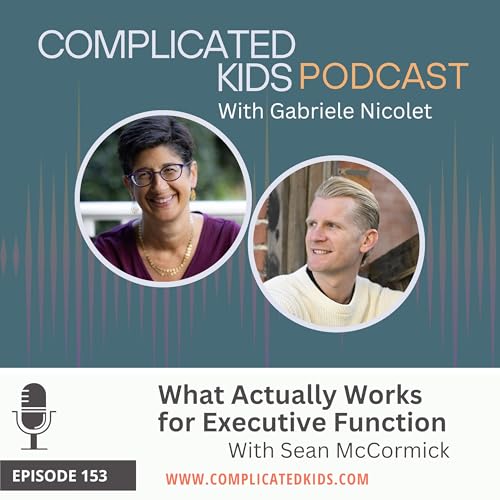
  • What Actually Works for Executive Function with Sean McCormick
    May 12 2026
    You cannot teach executive function by controlling a child harder. Executive function is not just about planners, homework, and getting organized. It is about self-awareness, self-regulation, and being able to take the next step toward a goal, even when something feels hard. In this episode, I talk with Sean McCormick, founder of Executive Function Specialists, about what actually helps kids build executive function skills. We unpack why avoidance is often a sign that something feels too hard, why motivation works better when it connects to a child's own goals, and why adults need to stop trying to control kids and start getting more curious about what is getting in the way. Sean shares practical ways to break big goals into doable steps, explains why support should be done with kids instead of for them, and makes a strong case for modeling executive function in our own lives too. Key Takeaways Executive function is bigger than school skills. It includes planning, organization, self-awareness, time awareness, inhibition, emotional regulation, and the ability to evaluate priorities and move toward a future goal.Emotional regulation is part of executive function. Kids cannot plan, prioritize, or get started well when they are overwhelmed and not aware of what they are feeling.Avoidance usually tells us something important. When a child keeps avoiding homework or a task, it often means the task feels too hard, too big, too unclear, or too emotionally loaded.Real growth happens at the point of performance. Executive function skills are built in the moment a child is facing the actual challenge, not only through lessons about skills in the abstract.Kids need the next right step, not the whole staircase. A big goal becomes more manageable when adults help break it down into a challenge that feels just doable enough.Motivation works better when it belongs to the child. Kids are more likely to engage when they can connect daily tasks to something they want for themselves, not just something adults want from them.Adults have to notice the nonverbal signs. Body language, shutdown, avoidance, and tone often tell us more than a child's words about when something feels too hard.Support works best when it is done with a child, not for them. Co-regulating, helping them get started, and gradually releasing responsibility builds skill without taking away agency.Failure is not the end of the process. Failure gives feedback. Natural consequences can help kids learn, especially when an adult helps them reflect and recover instead of shaming them.Adults need to model executive function too. Kids learn from how we manage our own energy, limits, priorities, and stress. Burned-out adults cannot effectively teach sustainable regulation. About Sean McCormick Sean McCormick is a former public school special education teacher and the founder of Executive Function Specialists, an online coaching company that supports students with ADHD and autism in building executive function skills. He also founded the Executive Function Coaching Academy to train educators and professionals in executive function coaching, and co-founded UpSkill Specialists to support neurodivergent adults. Sean is passionate about helping students and families understand the practical skills that make everyday life more manageable and meaningful. About Your Host, Gabriele Nicolet I'm Gabriele Nicolet, toddler whisperer, speech therapist, parenting life coach, and host of Complicated Kids. Each week, I share practical, relationship-based strategies for raising kids with big feelings, big needs, and beautifully different brains. My goal is to help families move from surviving to thriving by building connection, confidence, and clarity at home. Complicated Kids Resources & Links 🌎 Website: www.gabrielenicolet.com 📅 Schedule a free intro call: Book here 📺 Subscribe on YouTube: Complicated Kids YouTube Channel 👾 Grab Tell the Story (anti-anxiety tool for kids): Tell the Story ➡️ Instagram: @gabriele_nicolet ➡️ Facebook: facebook.com/gabriele.nicolet ➡️ LinkedIn: Gabriele Nicolet on LinkedIn 🌺 Free "Orchid Kid" Checklist: Download the Checklist Enjoying the Show? If Complicated Kids has been helpful, the best way to support the podcast is to follow, rate, and leave a quick review. It helps other parents find the show — and it means a lot. If there's a topic you'd love to hear covered on a future episode, you can always reach out at podcast@complicatedkids.com. I love hearing what's on your mind and what would support your family. Thank you for being here. 💛
    Show More Show Less
    29 mins
  • Why Good Kids Get Bad Grades with Dr. Linda Silbert
    May 5 2026

    Sometimes a grade becomes the whole story.

    A child gets a low score, forgets an assignment, melts down over homework, or seems unmotivated, and suddenly everyone is focused on performance. But in this conversation, Dr. Linda Silbert brings us back to something much more important: a struggling child is still a whole child. Grades may show that something is wrong, but they do not explain why.

    Gabriele and Dr. Silbert talk about the many reasons good kids can struggle in school, from weak reading skills and poor study habits to family stress, overscheduling, lack of sleep, and the emotional weight kids carry every day. They talk about how often children are expected to know how to study, organize themselves, and manage demands they were never actually taught to handle. They also explore how parents can shift from reacting to grades to getting curious about the cause.

    This episode is also a strong reminder that learning has to fit the child. Dr. Silbert shares how play, connection, and simple strategies can unlock progress in ways pressure never will. It is a hopeful conversation about seeing children clearly, supporting them practically, and letting go of the idea that a report card tells you everything you need to know.

    Key Takeaways
    • Bad grades are often a symptom, not the real problem. Looking only at the grade can keep parents from seeing the stress, skill gaps, overload, or unmet needs underneath it.
    • Many kids are told to study harder without ever being taught how to study. Study skills, organization, and planning are learned skills.
    • Parents help most when they act like an ally, not an adversary. Sitting beside a child and staying calm can change the emotional tone of learning.
    • Overload matters. Too much activity, too little sleep, too much screen time, and too much pressure all affect learning and regulation.
    • Children cannot do well when basic needs are not being met. Hunger, exhaustion, stress, and lack of connection all get in the way.
    • Disorganization and avoidance are often signs of missing skills or too much stress, not laziness.
    • Learning has to match how the child's brain works. Play and engagement can unlock progress more effectively than pressure.
    • Self-esteem is shaped by how children experience school and home, including tone, reactions, and expectations.
    • Families need priorities, not perfection. It helps to step back and decide what matters most right now.
    • The goal is to see the whole child. Grades and performance only tell part of the story.
    About Dr. Linda Silbert

    Dr. Linda Silbert is an educational counselor, dyslexia therapist, and longtime educator with decades of experience helping children and families understand the reasons behind school struggles. Her work focuses on the whole child, with an emphasis on self-esteem, learning differences, study skills, and practical support that fits real family life. She is the author of Why Good Kids Get Bad Grades: What Parents Need to Know and Do and the founder of Strong Learning.

    About Your Host, Gabriele Nicolet

    I'm Gabriele Nicolet, toddler whisperer, speech therapist, parenting life coach, and host of Complicated Kids. Each week, I share practical, relationship-based strategies for raising kids with big feelings, big needs, and beautifully different brains. My goal is to help families move from surviving to thriving by building connection, confidence, and clarity at home.

    Complicated Kids Resources and Links
    • 🌎 www.gabrielenicolet.com
    • 📅 Schedule a free intro call
    • 📺 Subscribe on YouTube
    • 👾 Tell the Story (anti-anxiety tool)
    • ➡️ Instagram
    • ➡️ Facebook
    • ➡️ LinkedIn
    • 🌺 Free "Orchid Kid" Checklist
    Enjoying the show?

    If Complicated Kids has been helpful, the best way to support the podcast is to follow, rate, and leave a quick review. It helps other parents find the show and it means a lot.

    If there's a topic you'd love to hear covered on a future episode, reach out at podcast@complicatedkids.com. I love hearing what would support your family.

    Thank you for being here. 💛

    Show More Show Less
    30 mins
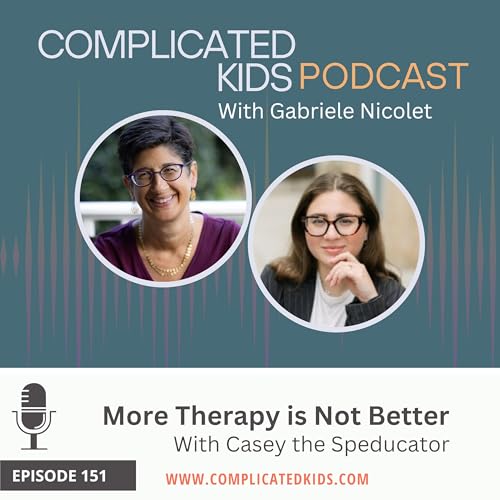
  • More Therapy is Not Better with Casey the Speducator
    Apr 28 2026
    A child can need support and still have too much support. In this conversation, I talk with Casey Joseph, special educator and founder of Casey's Special Education Services, about what happens when families get handed a long list of recommendations and start trying to do all of it at once. Casey shares why "more" is not always the best answer for neurodivergent kids, especially when services start to crowd out rest, connection, regulation, and ordinary family life. We talk about the hidden cost of too many appointments, too many providers, and too many moving pieces, and why parents need permission to step back and ask what is truly necessary right now. We also get into the practical side of this: how to think about a child's most urgent needs first, why fit matters more than quantity, when it may make sense to pause or reduce services, and how seasons of life affect progress too. Casey offers a thoughtful framework for choosing support with more intention and less panic, so families can build something sustainable instead of piling on one more thing just because it sounds helpful. Key Takeaways More services do not automatically mean better outcomes. A child can benefit from support and still become overwhelmed by too many appointments, transitions, and expectations.Parents need permission to be intentional. It is okay to ask what is most important right now instead of trying to address every need at the same time.Burnout matters for kids too. If a child is spending all day holding it together at school, adding too many after-school supports can push them past capacity.Burnout in parents affects the whole system. When a parent is juggling too many providers, updates, schedules, and logistics, that stress often gets felt by the child.Fit matters as much as access. A therapist, tutor, or clinician may be wonderful and still not be the right person for a particular child or diagnosis.Support should match the real priority. Sometimes the first need is regulation, anxiety support, sensory support, or basic physical needs, not academics.Services can change over time. A child may need something intensely for one season, then need less, a break, or something different later.Progress is not linear. Some parts of the year are naturally harder, and families do not need to panic if growth looks slower during stressful or draining seasons.Multidisciplinary support can help when it reduces stress. Sometimes one clinic or one coordinated team makes more sense than managing many separate providers.A good question for families is not only "What could help?" but also "What is giving us a real return on the investment of time, money, and energy?" About Casey Joseph Casey Joseph is the Executive Director and Founder of Casey's Special Education Services, LLC. She is a special educator who has built a team of special education teachers providing one-on-one support, tutoring, and consultation for families across the DMV. Casey's work focuses on children who learn differently and benefit from individualized support grounded in special education expertise. Her approach is collaborative, strengths-based, and centered on helping families find support that is both meaningful and sustainable. About Your Host, Gabriele Nicolet I'm Gabriele Nicolet, toddler whisperer, speech therapist, parenting life coach, and host of Complicated Kids. Each week, I share practical, relationship-based strategies for raising kids with big feelings, big needs, and beautifully different brains. My goal is to help families move from surviving to thriving by building connection, confidence, and clarity at home. Complicated Kids Resources and Links 🌎 www.gabrielenicolet.com 📅 Schedule a free intro call: Book here 📺 Subscribe on YouTube: Watch here 👾 Grab Tell the Story (anti-anxiety tool for kids): Learn more ➡️ Instagram: Follow here ➡️ Facebook: Connect here ➡️ LinkedIn: View profile 🌺 Free "Orchid Kid" Checklist: Download here Enjoying the show? If Complicated Kids has been helpful, the best way to support the podcast is to follow, rate, and leave a quick review. It helps other parents find the show and it means a lot. If there's a topic you'd love to hear covered on a future episode, you can always reach out at podcast@complicatedkids.com. I love hearing what's on your mind and what would support your family. Thank you for being here. 💛
    Show More Show Less
    24 mins
adbl_web_anon_alc_button_suppression_c
No reviews yet