Blended cover art

Blended

Blended

By: Sarah Barnes-Humphrey
Listen for free

Welcome to Blended – the podcast where transformative conversations spark real change. Imagine the raw honesty of a Red Table Talk, but with a laser focus on the critical conversations around inclusion in the workplace. Each episode brings together five individuals from vastly different walks of life, creating a vibrant space where unique perspectives collide, and meaningful dialogue takes center stage. We tackle the topics others shy away from, addressing the uncomfortable, the overlooked, and the necessary with authenticity and courage. If you're ready to challenge your assumptions, embrace new perspectives, and gain actionable insights into creating truly inclusive environments, this is the podcast you can't afford to miss. Let's lean in, listen, and grow together. Economics Social Sciences
Episodes
  • 68 - Between Two Voices: Understanding Code-Switching
    Jun 19 2026
    Between Two Voices: Understanding Code-Switching Welcome back to Blended! Today, we're talking about code-switching. A couple of episodes ago, my panel and I were talking about intersectionality, this phrase come up and, I have to admit, I hadn't heard it before. It's one of the things I love about Blended, it always throws up something new. And I thought that, if it was new to me, it might be new to some of you as well. So we wanted to give code-switching its own deep dive. Today we'll be talking about what it means, why it happens, the hidden toll of sacrificing personal authenticity to fit in – and what we can do to create inclusive environments for everyone. IN THIS EPISODE: [00.54] Introductions to our Blended panelists. · Leah – Author · Jeff – Community Consultant and Executive Producer and Host of Beats, Rhymes y Comunidad podcast · Dr Lola – ERG Strategist and Founder and Executive Director at Immigrants in Corporate [06.22] The group explore what code-switching means and why it happens, and share some personal examples. · Inauthenticity · Altered: o Mannerisms o Dress o Language o Body Language Context · Perception · Acceptance · Bias · Conscious/unconscious · Professionalism/credibility · Intent · Stigma · 'Cookie cutter' mold in the workplace · Archetypes – European white male centric · Patriarchy · Impact of 'casual' tech CEO's · Raising children to code-switch · Awareness · Generational differences · Accountability · Too much, or not enough · Socioeconomic impact · Exhaustion · Diversity · Normalization · Fear of change – what are you really afraid of? · Ignorance · Courage to call things out "It's how you alter the way you show up, whether it's in a conversation or an environment, from your mannerisms, your body language, the way you dress. Anything that's an inauthentic version of yourself that you're presenting in an effort to gain approval or acceptance." Jeff "I was raised on it… It was expected of us. This is what you do to adjust, to do the best you can to eliminate bias and assimilate into what's acceptable." Leah "It's changing. I'm being more intentional about creating a code of my own, because there's been too much stigma around how we show up – especially in the workplace." Jeff "It's a burden, a backpack of rocks. But, after a while, we get used to it." Leah "As a black woman in America, you can't talk about this without talking about race and gender… Sometimes code-switching becomes armor… but it's exhausting." Dr Lola "Sometimes when we think about change it can get so big that you retreat, it almost feels impossible. Then I realized it just had to start with me... If you check yourself each time you're afraid and ask yourself, 'what about that bothers me so much?,' then you're creating an atmosphere that allows people to be themselves." Leah [42.13] The panel reflect on the mental health impacts of code-switching, and how it shows up in community. · Identity · Shrinking yourself · Belonging · Code-switching with ill-intent · Recognition · Permission · Setting the tone · Culture · Forcing people to conform "We talk about the word belong, but we don't actually interrogate what that requires." Jeff "How do we attract a different culture? If people are code-switching – intentionally or unintentionally – it's because something about that environment has told them they need to." Dr Lola [57.19] The group discuss responsibility and who should take ownership of code-switching. · Leadership · Safe spaces · Empathy · Grace · Understanding · Support · Curiosity · Allyship · Boundaries · Education · Open dialogue · Power · Visibility "The leader has a responsibility to set the tone. I think, as individuals, we're always going to need to code-switch to a certain extent, but you shouldn't have to code-switch consistently, to your detriment." Dr Lola [01.06.56] The panel share ideas for what leaders can do to tackle code-switching in the workplace. · Training · Impact of AI ...
    Show More Show Less
    1 hr and 25 mins
  • 66 - Intersectionality: the next frontier for inclusive workplaces
    Apr 22 2026

    Welcome back to Blended!

    Today, we're talking about intersectionality.

    This is something that comes up a lot as part of our conversations here on Blended. But often it's when we're really exploring personal identities and sharing our experiences. And, the more we dive into the workplace, the more the nuance of intersectionality tends to disappear. There's an ERG for this type of person, a policy for that type – but what if you're both? When it comes to understanding the complexity of human identity, corporate is still lagging behind.

    But, in a climate where DEI is being eroded altogether, how can businesses put a focus on intersectionality – and why is it actually important?

    IN THIS EPISODE:

    [00.59] Introductions to our Blended panelists.

    · Jodi – Founder and CEO at NIARA Consulting

    · Marjorie – Director of Community at Exos, Founder and Principal Strategist at Community by Association, and podcast host

    · Eileen – Founder and CEO at Apex Tide Consulting

    · Dr Dequies – Founder and CEO at We Suite Women's Empowerment Consulting and Associate/Adjunct Faculty in organizational development and leadership

    "I'm black and biracial so I've always lived between two identities… I live this topic every day and I see how it has, and has not, changed across cultures and communities." Jodi

    [12.51] The group share their personal experiences and examine what intersectionality means to them.

    "Intersectionality is every identity that you carry, and it doesn't always look like a textbook definition. As a person in academia, I can say a lot about what the research may say. But, for me, it's not just my gender, race or sexuality… Everything plays a role in how I show up." Dr Dequies

    "It's also your life experiences and how you've had to navigate the world. Intersectionality includes all of the challenges you've had to overcome, the successes you've seen, the experiences you've gained… It's a rich ecosystem." Marjorie

    • Identity
    • Personal values/ethics
    • Layered approach
    • Life experiences/how you've navigated the world
    • Personal challenges and successes
    • Asking questions
    • Having deeper conversations
    • Code switching
    • Culture
    • Socio economics
    • Expectations
    • Safety
    • Subjective
    • Diversity
    • Judgement
    • Labels

    "It's the reality that we don't experience identity in siloes. We experience it all at once... So when organizations try to simplify identity into neat categories for ERGs, where do you go?" Jodi

    "The best visual is the iceberg. So much of a human is below the waterline, but we only see a little bit… We fall into the trap of judging people by that bit… And if we look at humans through only one lens, we miss the truth of their experience." Eileen

    [32.03] The panel discuss how intersectionality interacts with bias, personally and professionally.

    "Ambiguity doesn't remove bias. It creates another form of it." Jodi

    • Cultural norms
    • Relatability
    • Assumptions/perception
    • External similarities do not necessarily equal shared experiences
    • Projection
    • Ambiguity
    • Bias in AI
    • Triggers
    • Conscious/unconscious
    • Weaponized incompetence
    • Accountability
    • Upbringing – how do you break the cycle?
    • Choice

    "Bias isn't just interpersonal. It can be structural, organizational, or technological… If our systems aren't designed with intersectionality in mind, they can replicate or amplify old inequities – but at a larger scale." Eileen

    Show More Show Less
    1 hr and 34 mins
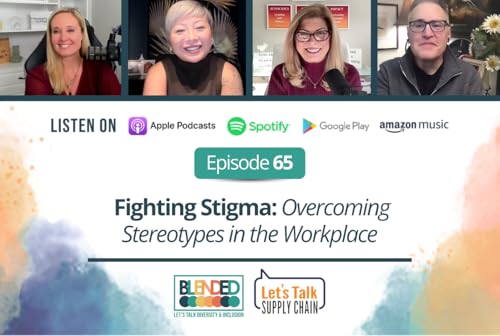
  • 65 – Fighting Stigma: Overcoming Stereotypes in the Workplace
    Feb 19 2026
    Welcome back to Blended! Today, we're taking on a big topic – stigma and stereotypes. As laws and recommendations continue to evolve at both federal and state levels, employers face an increasingly complex landscape. According to reports, some of the top challenges for employers in 2026 range from navigating compliance and whistleblowing, to dealing with issues around immigration and mental health and wellbeing. But, below all of this complexity, many employees find themselves dealing with versions of the same old problems. Stereotypes, stigma, and bias are still felt deeply by women, people of color, the LGBTQIA+ and disability communities, and more. So, whilst the big battles are happening at federal and state level, what can the rest of us do to address what it all means for employees on a day-to-day basis? Our guests are going to be diving into all of that today, and exploring addressing stigma and overcoming stereotypes in your organization. IN THIS EPISODE: [01.12] Introductions to our Blended panelists. · Jenny – Chief Executive Officer at Catalais Consulting · Tedi – President and CEO at MI Diversity Center · Robbin – Founder and CEO at Women Igniting Change [04.58] The group share their personal experiences, and discuss what stereotypes and stigma really mean, how they show up in the workplace, and their impacts. · Gender-based stereotypes, eg. Emotion or working mothers · Credibility · Belonging · Negative perceptions · Unfounded truths · Assumptions · Judgement · Blame · Inherited beliefs and values · Influence of family, society and culture · Identity · Language – words have power · Dehumanization · Lived experience · Fear/self-protection · Privilege · Jenny's experience of immigration and assimilation · Limiting potential · Racism · Top down examples/leadership · Sources of information/disinformation · Asking questions · Doing due diligence · Control · Us vs them narrative · Challenges of multigenerational workplaces · Right and wrong, true and false · Physical and mental impact · Intersectionality · Active listening · Robbin's experience of reverse agism and stereotyping around her personality type · Misogyny · Tedi's experience of identity stereotyping · Bias – implicit and explicit, conscious and unconscious · Stereotyping and labels within individual communities "Someone who expresses passion and empathy in the workplace is often framed as too emotional, rather than that being seen as a leadership strength. To me, that's a stereotype… The stigma is when we start to internalize that." Robbin "There's no such thing as a true stereotype!" Tedi "Stereotypes are assumptions, shortcuts we take to understand others quickly. Stigma is what happens when those assumptions get loaded with judgement or consequence." Jenny "Our own unexamined beliefs and values tend to ooze out onto other people, either intentionally or unintentionally." Robbin "Privilege is not the issue – what we do with it is... Blind spots are the not issue – refusing to look at them, acknowledge them, and then learn and grow from them IS." Jenny [55.39] The panel explore how to tackle issues around stereotyping and stigma in the workplace. · DEI mapping/auditing · Examining attitudes of leadership team and employees · Examining policies and practices · Tracking, meeting and celebrating goals/milestones · Awareness · Responsibility · Communication · Safety/culture · Authenticity · Separation between work self and personal self · Accountability · Respect · Equality · Impact of current political climate · Transparency · Vulnerability · Value systems "It takes culture to create a safe container for those conversations. When I was in corporate, part of the management style was fear and intimidation. There was no way it was safe enough to have this kind of dialogue." Robbin "It comes down to our core values. If our core values, as human beings, are aligned, it's OK if we have different beliefs. As long as those ...
    Show More Show Less
    1 hr and 19 mins
adbl_web_anon_alc_button_suppression_t1
No reviews yet