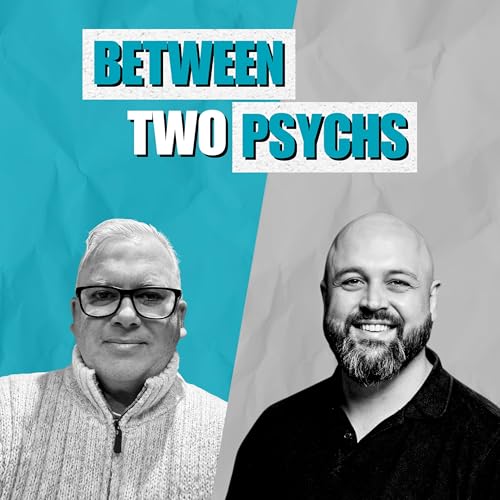
Between Two Psychs with Dr Adam McCartney and Mike Lane cover art

Between Two Psychs with Dr Adam McCartney and Mike Lane

Between Two Psychs with Dr Adam McCartney and Mike Lane

By: Dr Adam McCartney and Mike Lane
Listen for free

Summary

In this podcast Adam and Mike address all your education questions. They show the power of thinking psychologically can have on resolving everyday issues within education, learning and in raising happy children.Dr Adam McCartney and Mike Lane
Episodes
  • Ep. 24 - Talking about the Real Stuff!
    May 12 2026

    In this episode, we explore the realities many teachers face when supporting children with emerging autistic traits in mainstream classrooms, particularly in the early years, where needs are still being understood.

    The conversation centres around a reception teacher supporting a young child who struggles with communication, social interaction, routines, and engagement during classroom activities. Rather than focusing purely on behaviour, the episode looks deeper at development, asking what foundational skills may still need support before formal learning can truly begin.

    A key part of the discussion explores cause and effect, the early developmental understanding that “if I do this, something happens.” Mike and Adam unpack why this matters so much for communication, play, attention, and learning, especially for children who may experience the world very differently through sensory processing and social communication challenges.

    Its explores why play-based learning remains so important, particularly for children who are not yet ready for more formal teaching approaches. Instead of expecting children to immediately adapt to classroom structures, the conversation highlights the value of entering the child’s world first and building learning from there.

    Alongside this, there’s an honest reflection on the pressures teachers face. Managing large class sizes, differentiation and increasingly complex needs can feel overwhelming, especially when resources and support staff are limited.

    Importantly, this episode is not about “fixing” children. It’s about understanding development, adapting approaches and helping teachers find meaningful ways to support progress through curiosity, structure and connection.

    In This Episode, We Discuss

    • What schools can sometimes miss when supporting autistic children
    • Why behaviour is often linked to development, not defiance
    • The importance of cause and effect in early learning
    • How sensory experiences can impact communication and engagement
    • Why play-based learning remains essential in the early years
    • The role of executive functioning in preparing children for formal learning

    Why This Episode Matters

    Many teachers are trying to meet increasingly diverse needs without always having the time, training, or resources they need. This episode offers a compassionate and practical discussion about understanding children developmentally rather than simply behaviourally.

    It’s a reminder that meaningful progress often starts with understanding where a child truly is, rather than where we expect them to be.

    Connect with Mike Lane

    Website: ridgewaypsychology.co.uk
    LinkedIn: Michael Lane

    Connect with Me

    Instagram: @‌dradammcartney
    Website: dradammccartney.com
    YouTube: @‌Dr.AdamMcCartney

    Show More Show Less
    30 mins
  • Ep. 23 - Why Key Stage 3 Transitions Matter More Than We Think
    May 5 2026

    The transition into Key Stage 3 is often described as a fresh start, but for many young people, it’s where things quietly begin to unravel.

    In this episode of Between Two Psychs, we explore why the move from primary to secondary school can be such a vulnerable point, particularly for students who sit on the margins. We unpack the steady rise in exclusions between Years 7 and 9 and ask a deeper question: what does this transition feel like psychologically for children, and what are schools unintentionally missing?

    We talk about the shift from one secure relationship to many, from nurture to independence, and from feeling known to feeling lost in a much bigger system. Along the way, we explore concepts like learned helplessness, acceptance, autonomy, and happiness and why behaviour is often a signal of unmet needs rather than defiance.

    This is a conversation about connection, belonging and helping young people develop a sense of direction inside a system that can feel overwhelming.

    In this episode, we discuss:

    • Why exclusions rise so sharply during Key Stage 3
    • The psychological impact of moving from one key adult to many
    • How independence, when introduced too quickly, can increase distress
    • Learned helplessness and its link to disengagement and EBSA
    • Why “promoting happiness” may be more useful than “reducing exclusions”
    • The role of acceptance, shared identity, and belonging in student wellbeing
    • Why some students thrive in transition while others struggle
    • Starting transition work earlier, including the role of Year 5
    • Evidence-based supports like Friends for Life and Coping Cat
    • Using thoughts-feelings-behaviour models to support reflection and goal-setting
    • Community-focused goals versus purely academic targets
    • How small-group and coaching conversations can prevent exclusion
    • Why teacher reflection, supervision and support matter just as much as student intervention

    Why This Episode Matters

    Key Stage 3 is often the most overlooked phase in education but it’s where identity, belonging, and disengagement begin to crystallise.

    This episode invites educators, leaders and psychologists to look beyond behaviour and systems, and instead focus on acceptance, connection, and purpose. When young people can see where they fit, feel supported rather than dropped, and are helped to develop their own internal goals, school becomes something they can stay connected to not something they need to escape from.

    Because behaviour is rarely about refusal.
    More often, it’s about not feeling seen, safe, or accepted.

    Connect with Mike Lane

    Website: ridgewaypsychology.co.uk
    LinkedIn: Michael Lane

    Connect with Me

    Instagram: @‌dradammcartney
    Website: dradammccartney.com
    YouTube: @‌Dr.AdamMcCartney

    Show More Show Less
    29 mins
  • Ep. 22 - ADHD: Over diagnosed?
    Apr 28 2026

    In this episode, I explore a question that keeps coming up in education: Is Attention Deficit Hyperactivity Disorder over diagnosed or are we missing something deeper?

    To make sense of that, I take a step back into the history of mental health and how diagnosis became so focused on criteria and checklists. While systems like the DSM brought structure, they also shaped how we interpret behaviour, sometimes reducing complex experiences into a set of symptoms.

    I also touch on the Rosenhan study, which challenged how reliable those diagnoses can be and how much of a role perception plays.

    From there, the focus shifts to what this looks like in real life. When a child presents with inattention, impulsivity, or hyperactivity, it’s easy to label it. But it’s more useful to ask what’s sitting underneath. Research into adverse childhood experiences (ACEs) shows how much a child’s environment and experiences can shape how they behave and engage.

    There’s a biological side too, particularly around dopamine and regulation, but even that connects back to the environment. The level of stimulation children are exposed to today plays a big role in how they focus and respond.

    So where does that leave us?

    For me, it comes back to relationships. Whether there’s a diagnosis or not, children need to feel safe, understood, and connected. Small, consistent actions in the classroom can make a bigger difference than we often realise.

    In This Episode, I Explore

    • How the ADHD diagnosis has evolved.
    • Why behaviour might reflect experience, not just symptoms.
    • The impact of trauma and environment on attention.
    • How dopamine and stimulation affect learning.
    • Why relationships are key, with or without a diagnosis.

    Why This Episode Matters

    This isn’t about dismissing ADHD. It’s about widening the lens.

    When we look beyond the label, we’re more likely to respond with curiosity rather than judgment and that’s where meaningful support begins.

    Connect with Me

    Instagram: @‌dradammcartney
    Website: dradammccartney.com
    YouTube: @‌Dr.AdamMcCartney

    Show More Show Less
    23 mins
adbl_web_anon_alc_button_suppression_c
No reviews yet