• THE Crash is Imminent: Why Your Financial Planner Is An Idiot!
    Jun 1 2026

    New Hampshire businessman Sean Dempsey sits down with fellow entrepreneur Jason Summerfield to discuss a question that most investors would rather avoid: Are we staring down the biggest economic storm of our lifetimes, or is this just another round of doom-and-gloom predictions?

    The conversation is based on an article Sean published in January 2026, where he argued that the United States is facing an unprecedented convergence of financial risks. Jason isn't convinced. Like many Americans, he believes markets are resilient, downturns are temporary, and long-term investors are usually rewarded for staying the course.

    What follows is an honest conversation between two friends who see the world very differently.

    Sean lays out the evidence behind his concerns: nearly $900 billion in commercial real estate loans coming due, office vacancy and delinquency rates that rival or exceed those seen during the Great Financial Crisis, stock market valuations sitting near historic extremes, growing instability in global credit markets, a national debt that has crossed 100% of GDP, a Social Security system headed toward insolvency within the decade, record levels of consumer debt, and politicians in both parties continuing to spend money the government doesn't have.

    Jason challenges nearly every point. Markets have survived worse. Congress has always found a way to kick the can down the road. Most financial professionals continue to recommend staying invested and avoiding panic. Maybe the headlines look scary, but maybe that's all they are.

    Sean sees it differently. His argument isn't that any one of these problems will bring down the economy. It's that all of them appear to be arriving at the same time. Individually, each risk might be manageable. Together, they could create something far more dangerous in 2026.

    Whether you think Sean is sounding the alarm or sounding crazy, this episode tackles the data, the assumptions, and the uncomfortable possibility that today's record highs may be hiding serious cracks beneath the surface.

    Read Sean's original article here: https://the-opposition.com/2026/01/the-coming-crash-is-unlike-any-other-in-usa-history-a-perfect-storm/

    Show More Show Less
    30 mins
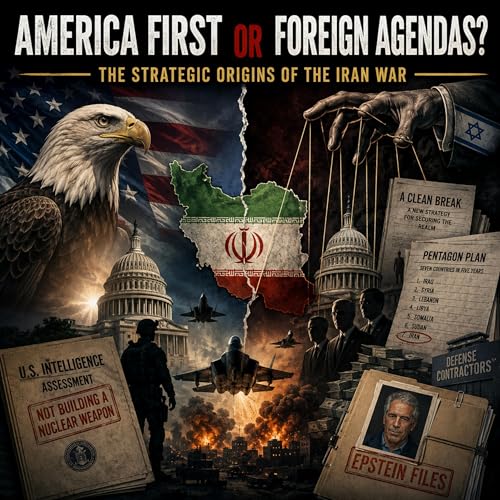
  • America First or Foreign Agendas? The Strategic Origins of the Iran War
    Jun 1 2026

    In this episode, we peel back the layers of the official narrative surrounding the 2026 war with Iran to uncover the structural, historical, and geopolitical drivers actually pulling the strings. For years, the public has been told that a nuclear-armed Iran is an imminent threat requiring preemptive military action. But what if the data from our own intelligence agencies says otherwise? Drawing on hundreds of reports, including 2003-2025 official US government sources for military intelligence data, we examine the stark disconnect between political rhetoric and the actual assessments of the U.S. intelligence community.

    In this episode, we cover:

      • The Intelligence Reality: We break down the consensus among U.S. spy agencies, including testimony from Director of National Intelligence Tulsi Gabbard and statements from former National Counterterrorism Center Director Joe Kent, confirming that Iran was not actively building a nuclear weapon prior to the war. We explore how Washington blurred the lines between Iran's nuclear "capability" and its actual "intent" to sell the necessity of a preemptive strike.
      • The Military-Industrial Complex: Why does the national security apparatus constantly drift toward confrontation? We discuss the "bureaucratic momentum" of defense contractors, think tanks, and military planners. After years of sanctions, proxy warfare, and military buildups, this massive infrastructure became deeply invested in escalation, making direct conflict almost inevitable regardless of the facts on the ground.
      • A Decades-Old Blueprint for Regime Change: We trace the strategic roots of this conflict back to the post-9/11 era. We revisit the shocking Pentagon memo revealed by four-star General Wesley Clark, which detailed a plan to take down "seven countries in five years" starting with Iraq and finishing with Iran. We also connect this to the 1996 "A Clean Break" strategy drafted by American neoconservatives for Benjamin Netanyahu, which advocated for abandoning "comprehensive peace" in favor of preemptive strikes and reshaping the Middle East's balance of power.
      • Foreign Influence & Political Leverage: Finally, we ask the hard questions about why America really went to war. Was it due to relentless pressure from Israel and its powerful American lobby, a dynamic explicitly called out by former counterterrorism chief Joe Kent? Furthermore, we dive into the controversial speculation surrounding the unsealing of the Jeffrey Epstein investigation files. Did the timing of this release act as a political "sword hanging over" President Donald Trump, leveraging him into military escalation in the Middle East to avoid domestic political embarrassment?

    Tune in as we separate the war propaganda from the geopolitical realities and ask the ultimate question: Is the war with Iran truly putting America First, or is it serving foreign agendas?

    Show More Show Less
    47 mins
  • LPNH v. LNC: The Great Libertarian Split. Principles, Power, and the Future of the Movement
    May 31 2026

    In this debate, one side advocates for the Libertarian Party of New Hampshire (LPNH) and other other takes the side of the Libertarian Party (LP). The debaters square off over one of the most contentious controversies in modern libertarian politics: the disaffiliation of LPNH and the future direction of the broader libertarian movement.

    Representing the LPNH perspective, one side argues that the Libertarian National Committee has become increasingly consumed by internal bureaucracy, procedural battles, and the policing of dissent while neglecting the existential threats facing liberty itself. They contend that Washington's growing debt, endless foreign interventions, inflation, surveillance, and federal overreach demand bold resistance, yet party leadership has chosen to focus its energy on disciplining state affiliates and enforcing organizational conformity. From this view, the disaffiliation fight symbolizes a deeper struggle between principled activism and institutional self-preservation.

    Defending the Libertarian Party's position, the opposing side argues that political organizations require standards, accountability, and a coherent public message if they hope to build a credible national movement. They maintain that affiliation is a voluntary relationship governed by agreed-upon rules and that no organization can survive if its members or affiliates disregard those standards. From this perspective, the dispute is not about suppressing dissent, but about protecting the party's reputation, electoral viability, and long-term effectiveness.

    At the heart of the debate lies a larger philosophical question: Should a liberty movement prioritize uncompromising defiance against the state, even at the risk of internal conflict and public controversy? Or must it balance principle with discipline, structure, and strategic messaging in order to grow and succeed politically?

    As both sides make their case, the discussion explores whether the libertarian movement is facing a temporary organizational dispute or a fundamental disagreement about the very nature of leadership, activism, and political change in America.

    Show More Show Less
    22 mins
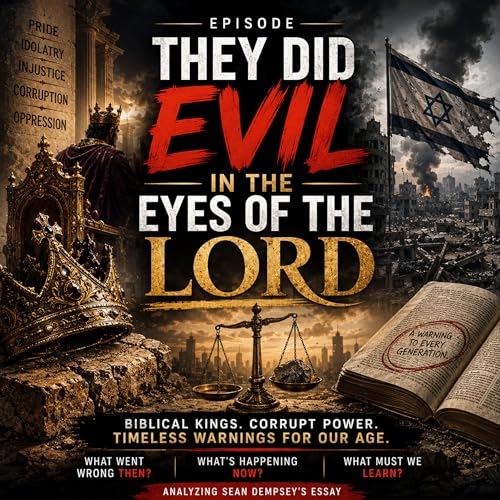
  • They Did Evil in the Eyes of the LORD: Biblical Kings, Gaza, Iran, and the Corruption of Power
    May 31 2026

    In this episode, the hosts examine and critique Sean Dempsey's essay They Did Evil in the Eyes of the LORD, which explores the recurring biblical theme of Israel's kings falling into corruption, pride, and injustice. The discussion analyzes Dempsey's argument that the biblical books of Kings provide a timeless warning about the dangers of political power, nationalism, and tribal loyalty, while drawing parallels to contemporary conflicts such as the war in Gaza. Along the way, the hosts wrestle with questions of moral accountability, the nature of leadership, and whether the same patterns that doomed the rulers of ancient Israel continue to shape nations and political movements today.

    Show More Show Less
    21 mins
  • Interview with Kevin Maley: Did Corporations De-Fang the Occupy Wall Street Movement?
    May 31 2026

    Did Corporate 'Wokeness' Hijack a Revolution?

    In this explosive interview from Sean Dempsey's 2024 book Trump Again?! How Could America Let This Happen?, Dempsey sits down with political activist, commentator, and grassroots organizer Kevin Maley to tackle a provocative question: Did America's largest corporations and financial institutions deliberately co-opt the energy of Occupy Wall Street to protect themselves from public outrage?

    Together, they explore the rise of corporate-backed Diversity, Equity, and Inclusion initiatives, ESG investing, and "woke" branding in the years following the financial crisis. Maley argues that many of these campaigns were not primarily designed to challenge entrenched power, but rather to redirect public anger away from Wall Street, corporate corruption, and growing economic inequality. Instead of a national conversation about class, wealth, and corporate influence, America found itself consumed by endless battles over identity, language, and culture.

    Drawing on years of political activism and movement-building experience, Maley contends that powerful institutions discovered a remarkably effective strategy: embrace the symbols of social justice while preserving the economic status quo. In this telling, the language of activism became a shield for corporate power, dividing potential populist coalitions and transforming a movement aimed at the "1%" into a thousand competing cultural grievances.

    Is corporate America genuinely committed to social progress? Or did it successfully de-fang a growing populist revolt by turning class warfare into culture warfare? This conversation challenges some of the most widely accepted narratives of the last decade and asks whether the real centers of power have been hiding in plain sight all along.

    Show More Show Less
    46 mins
  • Interview with Timothy Baxter - What Fueled Donald Trump's Reelection?
    May 31 2026

    In chapter 9 of the 2024 book "Trump Again?! How Could America Let This Happen?", Sean Dempsey interviews New Hampshire businessman Timothy Baxter.

    This interview kicks off a debate of the topic around the content of the discussion/interview.

    Tim discusses his opposition to identity politics, characterizing the movement as a strategic tool used by political figures to prioritize collective grouping over individual agency. Baxter argues that the Democratic Party leverages victimhood narratives to distract the public from substantive issues like economic failure and education. He highlights a significant divide within the LGBTQIA+ community, suggesting that the experiences of gay individuals differ fundamentally from those of transgender people. By emphasizing his identity as a business owner rather than his sexuality, he warns that woke ideology in schools may negatively impact the mental health of future generations.

    Ultimately, the interviewer and interviewee advocates for a diversity of viewpoints to counter the perceived ideological echo chambers of modern social movements.

    Show More Show Less
    24 mins
  • Trump's 2024 Reelection & the Deconstruction of Wokeism in America
    May 31 2026

    In his critically acclaimed 2024 political expose "Trump Again? How Could America Let This Happen?" Sean Dempsey examines the concept of 'Wokeism' through a Metamodern lens, exploring how language, identity, and political ideology have become deeply intertwined in contemporary culture.

    Drawing on George Orwell's warnings about the corruption of language, he critiques the rise of euphemistic and ideologically charged terminology while investigating the growing public backlash against these cultural trends. The episode asks a fundamental question: when does the pursuit of inclusion begin to undermine clarity, common sense, and meaningful dialogue? Let's dive deep...

    Show More Show Less
    50 mins
  • Interviewing Brendan Dempsey: Beyond Wokeism - The Metamodern Path to Cultural Synthesis
    May 31 2026

    Chapter 9 of Sean Dempsey's 2024 book "Trump Again?! How Could America Let This Happen?" explores the evolution of cultural paradigms, moving from the deconstructive nature of Postmodernism toward a more integrated framework called Metamodernism. The

    Sean Dempsey and his brother Brendan discuss how "Wokeism" may represent a simplified, often distorted version of academic sociology that lacks the necessary complexity to address modern issues effectively. They discuss how current identity-based politics can become regressive and divisive when nuanced theories are "downwardly assimilated" into rigid, popular slogans.

    To overcome this cultural friction, the sources advocate for a dialectical synthesis that transcends current polarities by balancing social awareness with objective reality. Ultimately, the dialogue expresses optimism for a future where society moves beyond reactionary "culture wars" toward a more mature and stable civilization. Can society move beyond juvenile, Postmodern concepts like 'Wokeism' and enter into a new metamodern synthesis? Let's discuss.

    Show More Show Less
    18 mins