

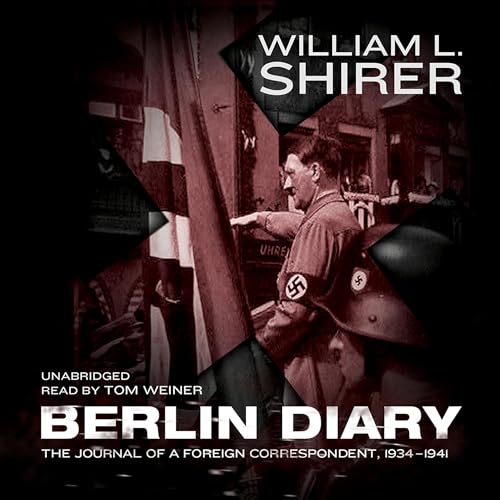
Berlin Diary
The Journal of a Foreign Correspondent, 1934–1941
Failed to add items
Add to basket failed.
Add to wishlist failed.
Remove from wishlist failed.
Adding to library failed
Follow podcast failed
Unfollow podcast failed
Get 30 days of Standard free

Berlin Diary
Buy Now for £16.94
-
Narrated by:
-
Tom Weiner
By the acclaimed journalist and New York Times best-selling author of The Rise and Fall of the Third Reich, this day-by-day eyewitness account of the momentous events leading up to World War II in Europe is the private, personal, utterly revealing journal of a great foreign correspondent.
CBS radio broadcaster William L. Shirer was virtually unknown in 1940 when he decided there might be a book in the diary he had kept in Europe during the 1930s—specifically those sections dealing with the collapse of the European democracies and the rise of Nazi Germany.
Shirer was the only Western correspondent in Vienna on March 11, 1938, when the German troops marched in and took over Austria, and he alone reported the surrender by France to Germany on June 22, 1940, even before the Germans reported it. The whole time, Shirer kept a record of events, many of which could not be publicly reported because of censorship by the Germans. In December 1940, Shirer learned that the Germans were building a case against him for espionage, an offense punishable by death. Fortunately, Shirer escaped and was able to take most of his diary with him.
Berlin Diary first appeared in 1941, and the timing was perfect. The energy, the passion, and the electricity in it were palpable. The book was an instant success, and it became the frame of reference against which thoughtful Americans judged the rush of events in Europe. It exactly matched journalist to event: the right reporter in the right place at the right time. It stood, and still stands, as so few books have ever done, a pure act of journalistic witness.
©1941 William L. Shirer (P)2011 Blackstone Audio, Inc.Critic reviews
Great insight into 1930s/40s Germany
Something went wrong. Please try again in a few minutes.
History as it happened. The frustration of Shirer in not being possible to broadcast the full truth about what was happening is plainly evident.
Michael
Something went wrong. Please try again in a few minutes.
Very good.
Something went wrong. Please try again in a few minutes.
If you could sum up Berlin Diary in three words, what would they be?
A fascinating account of the acquisition of power by the Nazis, their use of propaganda, the acquiescence of the population-and indeed other governments-the momentum towards war and the brutally efficient execution of the early phases of that war by the German military. If I had to choose just three words to sum up the story, they would be evil, capitulation, hope. My three words to characterize the book would be humane, perceptive, life-affirming.Which scene did you most enjoy?
I particularly enjoyed the scene in which Shirer was approached by a Nazi censor wielding a transcript of a radio transmission made by one of Shirer's colleagues. After reading it and concluding that the correspondent's ironic tone had perhaps been slightly overdone, Shirer was preparing, nevertheless, to defend the script. "What's the matter with it?" he asked. He was astounded to hear the German praise the script and tell Shirer that it was the sort of broadcast that Shirer might someday make if he could only overcome his anti-Nazi prejudice!If you made a film of this book, what would be the tag line be?
When illusions of civilization are shattered, can hope survive?Behind-the Scenes Bulletins from an Insightful Man
Something went wrong. Please try again in a few minutes.
it would be interesting to know if there is a British journalists diary from Germany in the same period or a German journalist reporting from London just prior to the out-break of war.
An Insight into Reporting from war-time Berlin
Something went wrong. Please try again in a few minutes.