

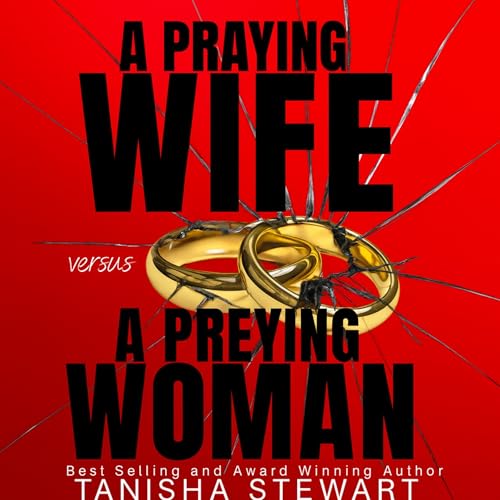
A Praying Wife vs a Preying Woman
A Christian Romance Thriller (Love Conquers All Thrillers, Book 1)
Failed to add items
Add to basket failed.
Add to wishlist failed.
Remove from wishlist failed.
Adding to library failed
Follow podcast failed
Unfollow podcast failed
Get 30 days of Standard free

A Praying Wife vs a Preying Woman
Buy Now for £18.39
-
Narrated by:
-
Katherine Dollison
-
By:
-
Tanisha Stewart
Summary
They wouldn't call it betrayal if it didn't come from a friend...
For lack of a better word, Destiny's life is perfect.
She met the man of her dreams her first week in college. Her grades are stellar, and she's got the lead role in the choir.
But someone in her circle isn't happy for Destiny's success.
And that person won't stop until she meets her demise.
Des always gets the short end of the stick.
She fights with everything she has to be noticed, but she's always overlooked.
Her roommate, Destiny, always seems to come out on the winning side. Things reach a head when Destiny sails by on a cloud of joy the same day Des faces the worst rejection of her life.
Out for blood, Des zeroes in on her so-called best friend.
Time to knock her down a peg or two.
A Praying Wife vs A Praying Woman is a spell-binding psychological thriller that will keep you up all night listening.
©2023 Tanisha Stewart (P)2023 Tanisha StewartContinue the series

What’s more troubling is that Des was fully prepared to murder her best friend and only failed because she was stopped, not because she had a change of heart. Her brief moment of guilt in the hospital didn’t feel like genuine repentance just a surface-level reaction and pleading to God because she was afraid of dying. She never truly owned up to everything, including the attempted murder or the manipulative way she pursued Shemar, who had originally been interested in Destiny.
True repentance requires confession, and that never happened. Yet somehow, Des still gets a happy ending walking away with Shemar, her family intact, and no real consequences beyond losing the friendship. It sends the wrong message: that someone can live wrongly for most of their life being absolutely evil and wicked harm others deeply, avoid full accountability, and still have everything work out without genuine repentance or transformation.
Considering this was intended to be a Christian story, that message feels especially off. You also have to consider that this all happened within the first year of the marriage, which makes it even harder to accept. The husband was portrayed as a strong, admirable man, yet he gave in far too easily. Letting him cheat with Des and soooooo quickly not only undermined his character, but also gave Des the satisfaction of infiltrating and damaging a marriage that was barely even established.
It makes his character feel inconsistent he was built up to be solid, yet he fell at the first real test. Meanwhile, Destiny, who remained loyal and did nothing wrong, is the one who suffers the most. She’s left with a broken friendship, a tainted marriage, and emotional damage she didn’t deserve.
What’s even more frustrating is that Des ultimately ends up with Shemar someone who, aside from leaving for a job opportunity, didn’t betray anyone in the same devastating way. So the question remains: why does the villain of the story come out on top, while the one who stayed faithful to her husband and to God pays the highest price?
A praying woman should not be written as someone who simply endures betrayal without restoration or justice. Either her marriage should have been protected from that level of infiltration, or if it was broken she should have been given the strength to walk away, with God bringing someone better, loyal, and aligned into her life. Instead, the story suggests that faithfulness leads to loss and enduring suffering, while wrongdoing goes largely unpunished and that’s not a message that sits right, especially for a book that appears to carry Christian themes.
The Villain Wins and It Doesn’t Sit Right
Something went wrong. Please try again in a few minutes.